McLED

Human-Centric Lighting

XLamp® CTW Tunable White LEDs for Seamless Tunability

The Cree LED XLamp® CTW Tunable White LEDs are a high-performance family of two- channel CCT-tunable white COB LEDs, designed for exceptional flexibility with 6500K/2700K, 5000K/2200K and 4000K/1800K options, lumen density, efficacy and reliability.

Published by LED professional ·
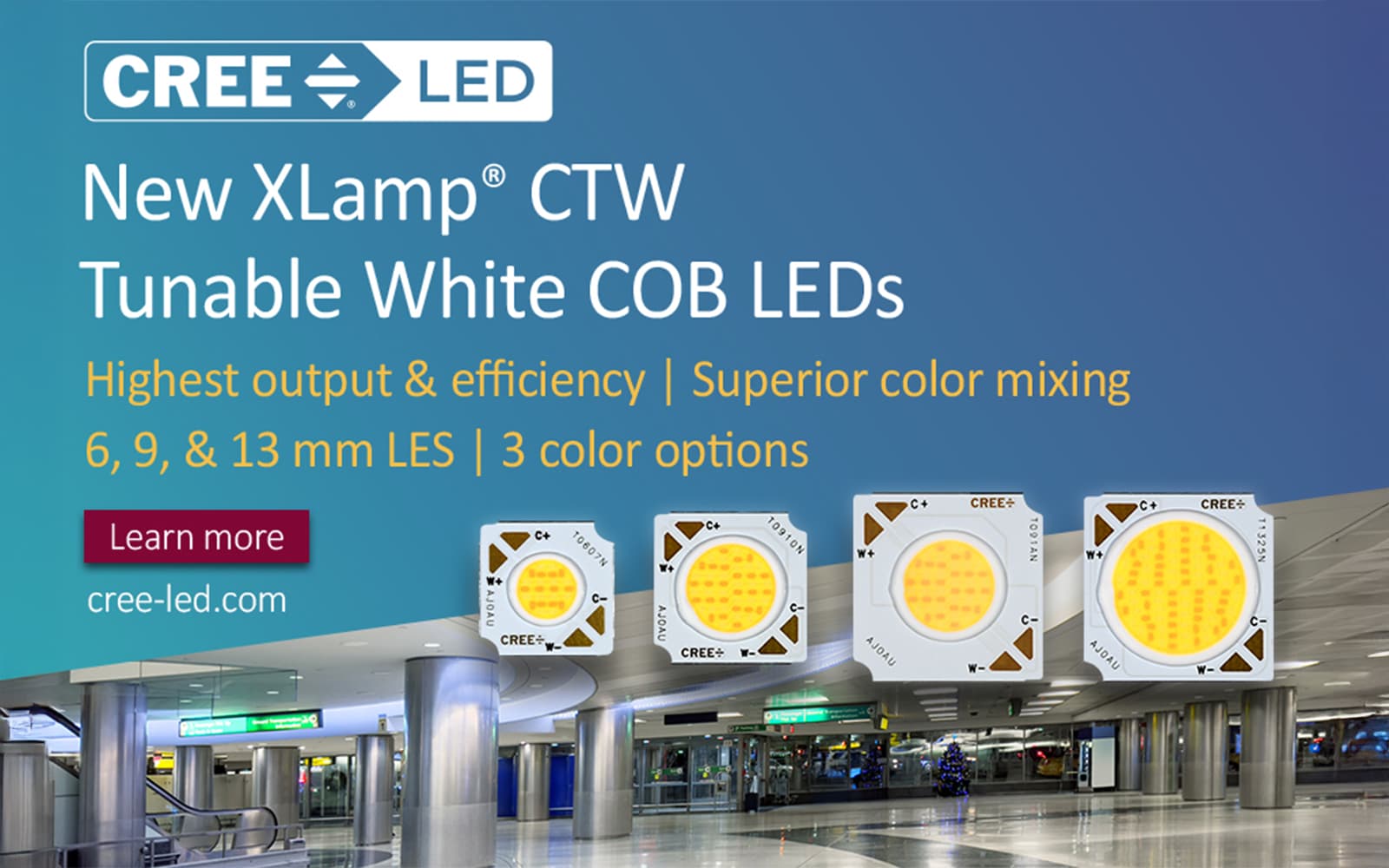
XLamp® CTW Tunable White LEDs for Seamless Tunability

Ideal for downlights, track lighting and tunable white or dim-to-warm fixtures in commercial, retail and hospitality settings. CTW LEDs simplify luminaire design by enabling smooth color temperature tuning with a single directional optic. They offer the highest lumen output and efficacy in their class, with compact LES sizes (6, 9, 13 mm) that ensure easy integration with existing XLamp optics. A checkerboard two-channel layout ensures superior color mixing through secondary optics, delivering a seamless and authentic lighting experience. Samples available now and production quantities available with standard lead times.

For more information about Cree LED XLamp® CTW Tunable White LEDs...

Cree LED offers one of the industry’s broadest portfolios of application-optimized LED chips and components, leading the industry in performance and reliability. Our team delivers best-in-class technology and breakthrough solutions for focused applications in high power and mid-power general lighting, specialty lighting and video screens. Cree LED develops products backed by expert design assistance, superior sales support and industry-best global customer service. cree-led.com

Did you like this article?

Share this article

You could also like this

Human-Centric Lighting

CIE publishes Technical Report CIE 259:2026 on visual ergonomics for display equipment

The CIE has published Technical Report CIE 259:2026, "Visual Ergonomics, Lighting and Visual Display Equipment" (ISBN 978-3-902842-81-7, DOI 10.25039/TR.259.2026). The report updates guidance on display screens, reflecting advances in display and computing technologies and addressing newer personal devices, varied viewing positions, advanced control functions, and potential adverse effects of prolonged screen use. It consolidates peer-reviewed visual ergonomics principles for indoor work environments, covering user health, digital eyestrain, spectacle lenses, display characteristics, lighting and environmental modifications, and metrics-related issues. The 35-page report includes two tables and is available from the CIE Webshop and National Committees.

Human-Centric Lighting

The aging eye and its influence on melanopic effects

Kevan Shaw, Lighting Consulting and Founder of KSLD. As the owner and operator of a pair of significantly aging eyes I have a considerable interest in how this effects my visual and non visual relationship with light. As a lighting designer who has been active for 50 years, I have had the idea that yellowing of the lens degrades visual performance significantly heavily promoted. Also, the idea that simply increasing illumination levels is a panacea that universally improves vision for the aged eye is the only solution.

Human-Centric Lighting

Beyond tunable white: spectral control for circadian lighting in healthcare

Xavier Denis, Head of Technical Support and Technical Marketing at Nichia Europe. For readers working with Human Centric Lighting (HCL), the broad principles will be familiar. Light exposure impacts more than visual performance. Healthcare is an application where its timing, intensity and spectrum deserve particular attention.

Human-Centric Lighting

Sunlight, UVB and vitamin D – Human Centric Lighting beyond melanopic stimulation

Ir. Rémy C. Broersma and Dr. Ir. Marcel P. Lucassen, Scientists at Signify Research Eindhoven UVB radiation initiates vital processes in our body, one of which is the production of vitamin D in the skin. It is well known that over-exposure to the sun may bring a risk. Less well known is that the same is true for insufficient sun exposure due to our indoor lifestyle. In Part 1 of this article, we first describe the scientific understanding behind vitamin D. In Part 2 we describe how artificial light can be enriched with a safe, low dose of UVB, to supplement natural vitamin D production in the skin. Not too much, not too little.

Luminuscree ledEdison optoTE connectivityLTF TechnologyLoreos

The latest Press Releases

Explore All

Stay current with our monthly Update from the lighting industry

LEDprofessional Newsletter

You will receive a confirmation e-mail. Unsubscribe anytime.