Human-Centric Lighting
Beyond Tunable White: Spectral Control for Circadian Lighting in Healthcare
by Xavier Denis, Head of Technical Support and Technical Marketing at Nichia Europe.
For readers working with Human Centric Lighting (HCL), the broad principles will be familiar. Light exposure impacts more than visual performance. Healthcare is an application where its timing, intensity and spectrum deserve particular attention.
Published by LED professional · · Updated
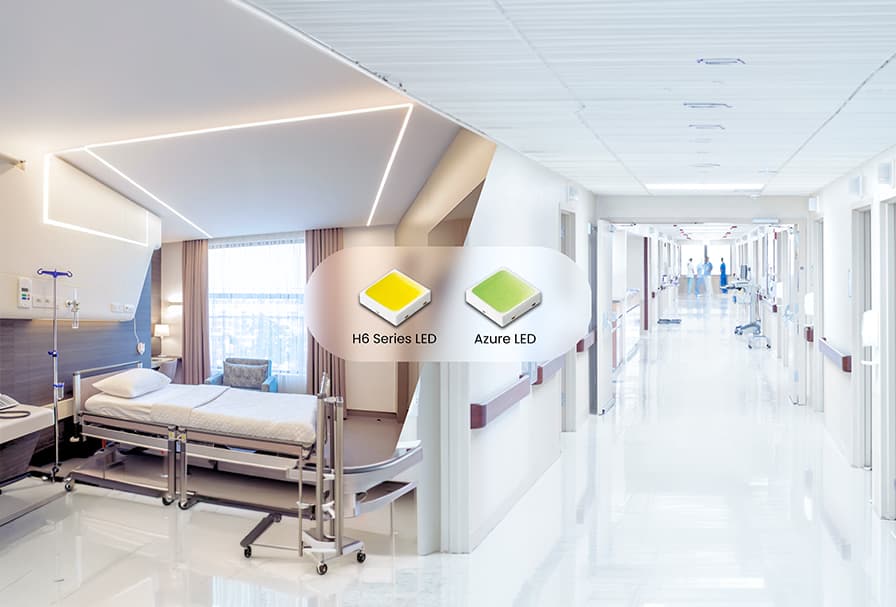
Yet many HCL systems still rely mainly on scheduled transitions between cool and warm white light. That may imitate the appearance of daylight changing, but correlated color temperature (CCT) alone does not define the melanopic stimulus reaching the eye.
The distinction is key in hospitals and residential care where patients and residents spend long periods indoors with limited access to daylight. Sometimes, their daily light exposure is determined almost entirely by electric lighting. Spectral power distribution (SPD), intensity, timing and duration are therefore integral to lighting design, not optional refinements.
Staff lighting must also support accurate visual work during examinations and treatment, including in the evening, without disturbing patients.
Moving Beyond CCT
Two sources with the same CCT can have significantly different spectral power distributions and, at the same photopic illuminance, they can produce different melanopic outputs.
Conventional tunable-white systems typically mix warm-white and cool-white LEDs. Adjusting the balance changes the CCT and usually changes melanopic output too, but the two variables remain closely linked. A system can move smoothly from 2700 K to 6500 K while offering limited control around the peak of the melanopic action spectrum.
Anyone who has specified tunable white will also know that an impressive CCT range on a datasheet says little about the light that ultimately reaches the eye. Distribution, output, surfaces, control settings and occupant position all alter the result.
Responses mediated by intrinsically photosensitive retinal ganglion cells (ipRGCs) are influenced by the complete spectrum at the eye, not the nominal CCT of the source. Melanopsin has an intrinsic peak sensitivity close to 480 nm. Once pre-receptoral filtering by the human eye is considered, the melanopic action spectrum defined by the International Commission on Illumination (CIE) peaks at approximately 490 nm.
Morning and daytime lighting should generally provide a higher melanopic stimulus which should decrease toward evening and remain low overnight. This requires control over the quantity and spectral composition of the light. CCT remains relevant to appearance and acceptance but should not be a substitute for melanopic equivalent daylight illuminance (EDI) or a spectral assessment.
Separating the LED Channels
Some HCL systems combine melanopic-enhanced and conventional white LEDs. Both channels, however, emit across broad and overlapping parts of the visible spectrum. Increasing one channel changes melanopic output, photopic output and visual appearance at the same time.
Greater spectral separation between the channels can extend the available control range, allowing higher melanopic output during the day and substantially lower output during the evening without depending entirely on a shift in CCT.
Dynasolis™ from Nichia adopts this approach in a unique way by combining an Azure channel, designed to provide greater output around 480 nm, with a warm-white channel containing much less relative energy in the same region. Mixing the channels allows CCT and melanopic content to be adjusted across a wider range than is normally possible by combining warm-white and cool-white LEDs.
Neither channel is spectrally isolated, nor does it need to be. What matters is the difference between their spectral distributions and the greater control that difference provides at system level.
Why the Cyan Region Matters
Phosphor-converted white LEDs generally use a blue pump near 450 nm to 455 nm, where InGaN emitters can provide high wall-plug efficiency. It is a proven architecture for white light, but its peak output does not align with the peak of the CIE melanopic action spectrum.
Shifting more photometric output towards the 480 nm to 490 nm range can increase melanopic effectiveness. A practical way to achieve it is by using a phosphor-converted cyan or Azure channel, which retains good luminous efficacy and allows the source to be mixed with warm white light.
As shown in Figure 1, the Azure LED provides enhanced output in the cyan region, where melanopic sensitivity is highest.
Matching the forward voltage and package height of the two LED types simplifies driver design, board layout and optical integration. Comparable source geometry also supports more uniform mixing through the secondary optic and reduces the risk of visible color separation across the beam.
Figure 1: Spectral comparison of an Azure LED and a conventional 6500 K white LED against the melanopic sensitivity curve.
Application in Hospitals
Hospital lighting must reconcile the needs of patients who may receive little natural daylight with those of staff requiring sufficient light for observation, examination, treatment and safe movement at any hour.
Figure 2 illustrates potential applications of the Dynasolis™ LED channels in patient rooms and other hospital environments.
For patients, electric lighting can strengthen the distinction between day and night. During the day, broad-area illumination should deliver light vertically at the eye rather than concentrating only on the horizontal working plane.
This is easily missed. A bed surface, table or floor may satisfy its illuminance target while comparatively little light reaches the patient’s cornea. A daytime HCL scene should therefore be assessed at the expected eye position, including when the patient is reclining.
The CIE’s 2024 position statement [1] cites a daytime recommendation of at least 250 lx melanopic EDI at the eye for healthy day-active adults. It recommends no more than 10 lx during the three hours before bedtime and no more than 1 lx during sleep.
These figures are not universal prescriptions. The daytime recommendation is based principally on research involving healthy adults. Age, ocular health, medication, clinical condition and previous light exposure can all affect the response. Hospital protocols, safety and individual patient needs must still take precedence.
At night, circadian considerations must be reconciled with observation and treatment. Intensive care, recovery spaces and general patient rooms require different scenes and control strategies.
Examination scenes may require high illuminance, good color rendering and close glare control. Lower-output scenes can support routine observation or circulation without exposing patients to short-wavelength-rich light throughout the night.
The credible objective is not to claim that lighting accelerates treatment. It is to support visual care, reinforce day-night contrast and avoid exposure likely to disrupt sleep or circadian timing.
Application in Retirement and Care Homes
The age-related changes affecting vision are well understood within the lighting industry. Reduced retinal illuminance, lower contrast sensitivity and slower adaptation mean that older residents may require substantially more task light than younger occupants, particularly for reading, crafts and personal care.
The appropriate level still depends on the task, eyesight, surface reflectance, contrast and glare. Simply adding more lumens can produce a brighter but less comfortable environment.
Care settings must also account for residents living with dementia. Strong shadows, reflections, abrupt contrasts and certain floor patterns may be misinterpreted as obstacles or changes in level. Good vertical illumination can support better facial recognition, communication and orientation.
During the morning and throughout the day, higher melanopic exposure at the eye can reinforce the daytime signal. In the evening, both illuminance and melanopic content should fall progressively. A warmer appearance may help to communicate that transition, but CCT does not tell the full technical story. The SPD and resulting melanopic EDI remain more useful.
Figure 3 illustrates a possible daily lighting sequence, moving from energizing light during active hours towards warmer, more relaxing light in the evening.
At night, lighting should be limited to what is necessary for orientation, observation and care. Distribution can be as influential as spectrum. Low-level light directed towards the floor may support movement while reducing exposure at the eye, if glare, adaptation and fall risks have been properly considered.
Some studies in care settings [2] have reported improvements in daytime activity and sleep following scheduled light exposure, although the results vary by population, dose and research method. However, a larger 2026 study [3] found no significant improvement in actigraphic sleep or rest-activity after three months of biodynamic lighting. Any claims of specific medical benefit should therefore be treated with caution.
From LED Spectrum to Delivered Exposure
Dynasolis supplies the spectral components required to create a wider range of melanopic output than conventional tunable-white systems. As shown in Figure 4, this is achieved by combining an Azure LED with enhanced cyan-region output and an H6 Series warm-white LED with low melanopic content.
Figure 4: Dynasolis™ spectral distributions: an Azure LED with enhanced cyan-region output and an H6 Series warm-white LED with low melanopic content.
The LED component itself, however, does not determine the effect on the occupant. That result depends on the complete luminaire, its optical distribution, output, position and control schedule. Surface reflectance, daylight contribution, room geometry and the occupant’s orientation also influence the result.
Healthcare HCL should therefore be designed and commissioned using measurements at representative eye positions, rather than relying only on luminaire output, horizontal illuminance or a scheduled CCT value. Melanopic EDI must sit alongside visual requirements, glare, color quality and energy use.
Spectral tuning offers more than a broader change in color appearance. Its value is the ability to manage melanopic content more deliberately while preserving the visual and practical performance required from a healthcare lighting installation.
For more information on Dynasolis from Nichia, visit: https://led-ld.nichia.co.jp/en/product/lighting_dynasolis.html
References
[1] Commission Internationale de l’Éclairage, CIE Position Statement on Integrative Lighting: Recommending Proper Light at the Proper Time, 3rd edition, 2024. View CIE Position Statement
[2] Alrahyani, M. et al., “Effects of applying biodynamic lighting on improving sleep, depression, and agitation in older adults with dementia: a pilot clinical trial”, Geriatric Nursing, Vol. 64, 2025, 103435. https://doi.org/10.1016/j.gerinurse.2025.103435
[3] Prins, A.J. et al., “Biodynamic lighting versus bright light effects on rest-activity rhythm and night-time sleep in nursing home residents with dementia”, BMC Geriatrics, Vol. 26, 2026, Article 620. https://doi.org/10.1186/s12877-026-07365-2
Xavier Denis, Head of Technical Support and Technical Marketing at Nichia Europe
Note: This technical article was published in LEDprofessional Review (LpR), Issue #116.