Human-Centric Lighting
Sunlight, UVB and vitamin D – Human Centric Lighting beyond melanopic stimulation
Ir. Rémy C. Broersma and Dr. Ir. Marcel P. Lucassen, Scientists at Signify Research Eindhoven
UVB radiation initiates vital processes in our body, one of which is the production of vitamin D in the skin. It is well known that over-exposure to the sun may bring a risk. Less well known is that the same is true for insufficient sun exposure due to our indoor lifestyle. In Part 1 of this article, we first describe the scientific understanding behind vitamin D. In Part 2 we describe how artificial light can be enriched with a safe, low dose of UVB, to supplement natural vitamin D production in the skin. Not too much, not too little.
Published by LED professional · · Updated
remy.broersma@signify.com, marcel.lucassen@signify.com, www.signify.com
Part 1: The Biology Behind Vitamin D
Light is a fundamental part of life on earth [1, 2], as important as food, air and water. The feeling of sunlight has a profound effect on people’s health and wellbeing, supporting our visual, emotional and biological processes. Part of that radiation is perceived as visible light, while other parts, like UV (ultra-violet) and IR (infra-red) are invisible for us, but not meaningless. Infrared brings us warmth and comfort, while UV can bring us the “sunshine vitamin”. On the other hand, overexposure to sunlight can bring sunburn. For most people knowledge ends there. When discussing Human Centric Lighting and its effect on our circadian rhythm (sleep-wake cycle), we often point out that people spend more than 90% of their time indoors [3]. This same fact is equally important when considering outdoor UVB exposure for maintaining sufficient vitamin D levels.
Research clearly shows that vitamin D levels vary throughout the year and that many people have insufficient vitamin D even during the summer months (Figure 1). Because modern lifestyles keep us indoors most of the time, and because sun-avoidance practices are common in many countries, a large proportion of the world's population simply does not get enough vitamin D.
Figure 1. Seasonal variation in average vitamin D levels in a UK cohort (after [5]), obtained from blood analysis. Indicated are three regions of the vitamin D level: sufficient (>75 nmol/L), insufficient (50-75 nmol/L) and deficient (< 50 nmol/L). Note that in wintertime vitamin D deficiency is common.
A recent global meta-analysis, based on blood measurements collected between 2000 and 2022, found that approximately 77% of people have insufficient vitamin D levels [4]. While it is often assumed that vitamin D deficiency is mainly a problem in countries at higher latitudes (i.e. further away from the equator), this is no longer the case.
Modern lifestyles mean that people spend most of their time indoors, regardless of where they live. In addition, in regions closer to the equator, high temperatures, humidity, and the growing impact of climate change can discourage people from spending time outdoors. As a result, vitamin D insufficiency is widespread across the globe.
The same study [4] showed that even in equatorial regions (between 20° south and 20° north latitude), more than 52% of people have insufficient vitamin D levels. Outside these regions, the prevalence is even higher, typically ranging between 75% and 85%.
Most people know that vitamin D levels tend to decrease during the winter months. As shown in Figure 1, vitamin D concentrations in winter can be as much as 50% lower than the levels typically reached during the summer. This seasonal variation highlights how strongly our vitamin D status depends on exposure to sunlight throughout the year.
Figure 2 shows a typical daylight spectrum, including visible light, infrared radiation, and ultraviolet (UV) radiation. UVC radiation is completely absorbed by the ozone layer and does not reach the Earth’s surface [6]. UVB radiation is only partially absorbed and plays a key role in the production of vitamin D in the skin [6, 7]. In contrast, UVA radiation is largely unaffected by the atmosphere.
Figure 2. Intensity of solar radiation as a function of wavelength, at noon on June 21 and December 21, on a horizontal surface at sea level, at latitude 50° N (after [9]). Note the intensity difference for summer and winter time, and the shift in the ultraviolet region.
The amount of UVB reaching the Earth depends on several factors, including latitude, altitude, ozone concentration, weather conditions, air pollution, and the time of day and year [8, 9]. The two graphs in Figure 2 compare summer and winter conditions at a latitude of 50°N under clear-sky conditions.
The graphs show that winter sunlight is not only less intense overall but also contains relatively less UVB radiation. This is because the sun is lower in the sky during winter, causing sunlight to travel through a thicker layer of atmosphere and ozone, which absorbs more UVB [10]. As a result, UVB exposure in winter can be about 26 times lower than in summer, while visible light levels (lux) decrease by only about a factor of four.
In real-world conditions, the reduction in UVB exposure is often even greater because winter months typically have more cloudy and overcast days [11, 12]. This large seasonal drop in UVB availability helps explain why vitamin D levels decline so significantly during the winter period. Also, due to lower temperatures we expose less skin to sunlight.
More than 80% of our vitamin D is produced through exposure to sunlight [13], while food contributes only a relatively small amount. As a result, maintaining healthy vitamin D levels through diet alone is difficult, and long-term supplementation is often needed when sunlight exposure is insufficient.
Once vitamin D is produced in the skin, it is converted in the liver and kidneys into its biologically active form. In this active state, vitamin D functions as a steroid hormone that plays an important role in health and wellbeing, influencing the function of many tissues and cells throughout the body.
Unfortunately, vitamin D levels have declined significantly since the 1970s. Several factors associated with modern lifestyles are thought to contribute to this trend:
- More people now live in urban environments rather than rural areas, where UVB exposure is often lower.
- A growing proportion of jobs are performed indoors instead of outdoors.
- In warmer climates, the widespread availability of air conditioning encourages people to spend more time inside.
- Increased use of indoor entertainment and digital media, such as television, gaming, and internet-based activities, has reduced time spent outdoors, particularly among children.
- Concerns about skin cancer have led many people to avoid direct sun exposure or to take extensive sun-protection measures.
Together, these lifestyle changes have substantially reduced the amount of UVB radiation people receive from sunlight, contributing to the widespread prevalence of low vitamin D levels observed today.
Data from the U.S. National Health and Nutrition Examination Survey (NHANES) show a significant decline in blood vitamin D levels between the 1988–1994 and 2001–2004 survey periods [14]. Over just one decade, the proportion of the population with sufficient vitamin D levels (≥75 nmol/L) decreased substantially.
The study concluded that existing recommendations for vitamin D supplementation may not be sufficient to address the increasing prevalence of vitamin D insufficiency.
This decline in vitamin D status is also reflected in the re-emergence of rickets (soft and weak bones), a disease caused by severe vitamin D deficiency. Studies from Japan [15] and the United Kingdom [16] have reported a threefold and fourfold increase, respectively, in the number of rickets cases over the past decade.
These findings suggest that vitamin D insufficiency is becoming more common. Reduced exposure to sunlight, combined with insufficient vitamin D supplementation, is believed to be a major contributing factor to this trend.
Important Notice of Supplementation vs UV Exposure
It is commonly assumed that vitamin D obtained through sunlight exposure and vitamin D obtained through food or supplements follow the same biological pathways and therefore provide the same benefits. As a result, taking vitamin D supplements during the winter is often considered a straightforward substitute for reduced sun exposure, and partly, it is.
However, there are several reasons to believe that vitamin D produced naturally in the skin through exposure to sunlight may offer broader biological benefits than vitamin D obtained through supplements alone.
Three key differences have been identified:
- Interaction with other biological pathways The production of vitamin D in the skin is closely connected to several other important biological pathways. The precursor molecule 7-dehydrocholesterol (7-DHC or pre-vitamin D), which is converted to vitamin D upon exposure to UV radiation, can alternatively be transformed by enzymatic processes into cholesterol (Figure 3). Cholesterol, in turn, serves as the precursor for a wide range of hormones, including cortisol. Studies have shown that cortisol levels exhibit seasonal variation, with concentrations generally higher during winter than during summer [17]. The substantial reduction in UV exposure during the winter months may contribute to increased synthesis of stress-related hormones such as cortisol. These interconnected metabolic pathways may also be influenced by circadian rhythms, with certain processes being more active during daytime and others predominating at night. Consequently, vitamin D supplementation may not replicate all of the complex biological interactions that are naturally triggered by sunlight-induced UV exposure.
- Production of additional biologically active compounds Sunlight-induced vitamin D synthesis in the skin produces not only vitamin D itself, but also a range of related vitamin D derivatives (like various lumisterol and tachysterol molecules) that may contribute to health and wellbeing [19]. These compounds are generally not present in conventional vitamin D supplements. Furthermore, research [20] may suggest that the specific derivatives produced may vary throughout the day as the UVB spectrum of sunlight changes, indicating a dynamic relationship with the body's circadian rhythm that is difficult to replicate through supplementation.
- Differences in transport and delivery within the body Vitamin D produced in the skin is transported and distributed through the body differently than vitamin D absorbed through the digestive system [21]. Studies suggest that these differences may affect the biological activity, effectiveness, and duration of action of vitamin D, potentially favoring the naturally synthesized form.
These distinct metabolic pathways may partly help explain why observational studies often show strong associations between sunlight exposure and health outcomes, while supplementation studies sometimes produce less consistent results.
While the risks of excessive sun exposure are widely recognized, the potential consequences of insufficient sun exposure receive much less attention.
This raises an important challenge: how can we obtain the benefits of UVB exposure while minimizing its risks? One possible approach is the use of artificial lighting enriched with carefully controlled, low doses of UVB radiation—providing enough exposure to support beneficial biological processes without exceeding safe limits. In other words, the goal is to achieve a balance: not too much, and not too little. This is visualized in a biphasic dose-response curve as shown in Figure 4.
Figure 3. Model for synthesis of vitamin D and cholesterol, from 7-DHC (pre-vitamin D) depending on sunlight exposure (after [18]). Note that the synthesis of cholesterol and vitamin D in the skin are utilizing the same precursor molecule.
Figure 4. Schematic diagram of the relation between ultraviolet radiation (UVR=UVA+UVB) exposure and the burden of disease (after [22]).
UV Benefits Beyond Vitamin D
In recent years, research has revealed that UV exposure activates many more metabolic pathways in the skin beyond the well-known production of vitamin D and its derivatives. These other pathways generate a variety of biologically active compounds that may provide systemic health benefits throughout the body through mechanisms that are independent of vitamin D.
As a result, the strong associations often observed between good health outcomes and high vitamin D levels may not be due solely to vitamin D itself but could also reflect the activity of these other UV-induced biological processes. Consequently, increasing vitamin D levels through supplementation may not necessarily provide all the health benefits associated with natural UV exposure, as it does not activate the full range of pathways triggered by sunlight.
UV light from the sun on the skin produces a variety of biologically active substances, including hormones, hormone-like compounds, immune signaling molecules, and neurotransmitters. These substances include stress-related hormones and peptides such as cortisol, ACTH (adrenocorticotropic hormone), β-endorphin, and melanocyte-stimulating hormones (MSH), as well as other molecules like nitric oxide (NO), melatonin metabolites, and other compounds derived from amino acids. Many of these molecules can enter the bloodstream and influence organs throughout the body, including the brain, immune system, and endocrine glands [23].
As a result, UV exposure can affect much more than just vitamin D levels. It helps regulate a wide range of biological functions that contribute to overall health and well-being. These effects depend on the wavelength of UV light and involve complex interactions between the skin, the brain, the immune system, and other organs. Because of these multiple pathways, vitamin D supplements (pills) alone may not replicate all the health effects associated with natural sunlight exposure.
Benefits of Sufficient UV Exposure and Vitamin D Levels
Vitamin D is an essential hormone that helps the body function properly. Its most important and scientifically established role is to help the body absorb and use calcium and phosphorus, two minerals that are vital for strong bones and teeth. Calcium also acts as a universal messenger inside cells. Virtually every cell type uses carefully controlled calcium signals to regulate processes such as muscle contraction, hormone secretion, neurotransmitter release, gene expression, cell growth, and energy production in mitochondria. Without sufficient vitamin D, the body cannot efficiently absorb these minerals, even when they are present in the diet.
One of the best-known benefits of vitamin D is its contribution to bone health. During childhood, vitamin D is necessary for proper growth and development of the skeleton. In adults, it helps maintain bone density and supports the continuous process of bone renewal and repair. Severe vitamin D deficiency can lead to soft and weak bones, causing rickets in children and osteomalacia in adults. Long-term deficiency may also contribute to an increased risk of osteoporosis and fractures, particularly in older individuals.
Vitamin D also plays an important role in muscle function. Muscle cells contain vitamin D receptors, which means they can respond directly to vitamin D. Adequate vitamin D levels support muscle strength, coordination, and balance. People with low vitamin D levels often experience muscle weakness and reduced physical performance. In older adults, maintaining adequate vitamin D status has been associated with a lower risk of falls because of its positive effects on muscle function and stability.
In addition to supporting bones and muscles, vitamin D helps regulate the immune system. It stimulates the production of natural antimicrobial compounds that help the body defend itself against infections like e.g. influenza, flu and COVID19 [24]. Vitamin D also helps keep the immune response balanced, allowing the body to fight harmful microorganisms while avoiding excessive inflammation that could damage healthy tissues. Scientists have observed associations between low vitamin D levels and a higher risk of several infectious and immune-related diseases, although research is still ongoing to determine the extent of these effects in different populations.
The above-mentioned functions represent the classical and most widely accepted health benefits of vitamin D.
Part 2: Supplementing Artificial UVB
To find the “sweet spot” for providing enough, but not too much UVB via an artificial source, we first need to know how much UV is required for a sufficient vitamin D level. We took the common advice of several national and international organizations as the starting point. Although the general advice per region varies, we deduced an average advice of seeking outdoor sunlight exposure for about 15 min between 10:00 and 15:00h, 2 to 3 times a week, between April and September, exposing the face, neck and hands (and preferably also the lower arms). To estimate the solar exposure at these moments in time we use a published Excel spreadsheet model for calculating solar spectral irradiance [9]. This model provides the spectral irradiance on a horizontal surface at sea level for a clear sky, at any selected geographical latitude, month, day of the month, and time of day. The model separately calculates the direct irradiance from the sun and the indirect (diffuse) irradiance from the sky. Combined, they deliver the total irradiance. We developed a custom method to convert from irradiance on the horizontal surface to the vertical surface, which is more applicable to the shape of a walking person. We took an average cloudiness (based on meteorological data) and an average sky visibility (obstruction from buildings and trees) into account. In Figure 5 the result of this simulation is shown for a 15 min walk at three geographical latitudes (40°, 50°, 60°), at noon at day 15 in the month. The vertical axis shows the Standard Erythema Dose (SED) which is a standardized unit used to measure the amount of erythema weighted ultraviolet (UV) radiation a person's skin receives from the sun, regardless of their specific skin type or sensitivity [25]. 1 SED corresponds to 100 J/m2 where the Joules are erythema weighted. As a rule of thumb, for the most sensitive skin type I (Fitzpatrick scale), a SED > 2 will initiate a sunburn. As Figure 5 shows, a 15-minute walk will not exceed this sunburn threshold. As expected, at lower latitude (more close to the equator) the UV exposure is higher.
Figure 5. Standard Erythemal Dose (SED) for a 15-minute walk around noon, on day 15 in the month, at three geographical latitudes. Basic irradiation from [9] was modified with a custom method for a walking person (see main text).
Measuring Solar Irradiance
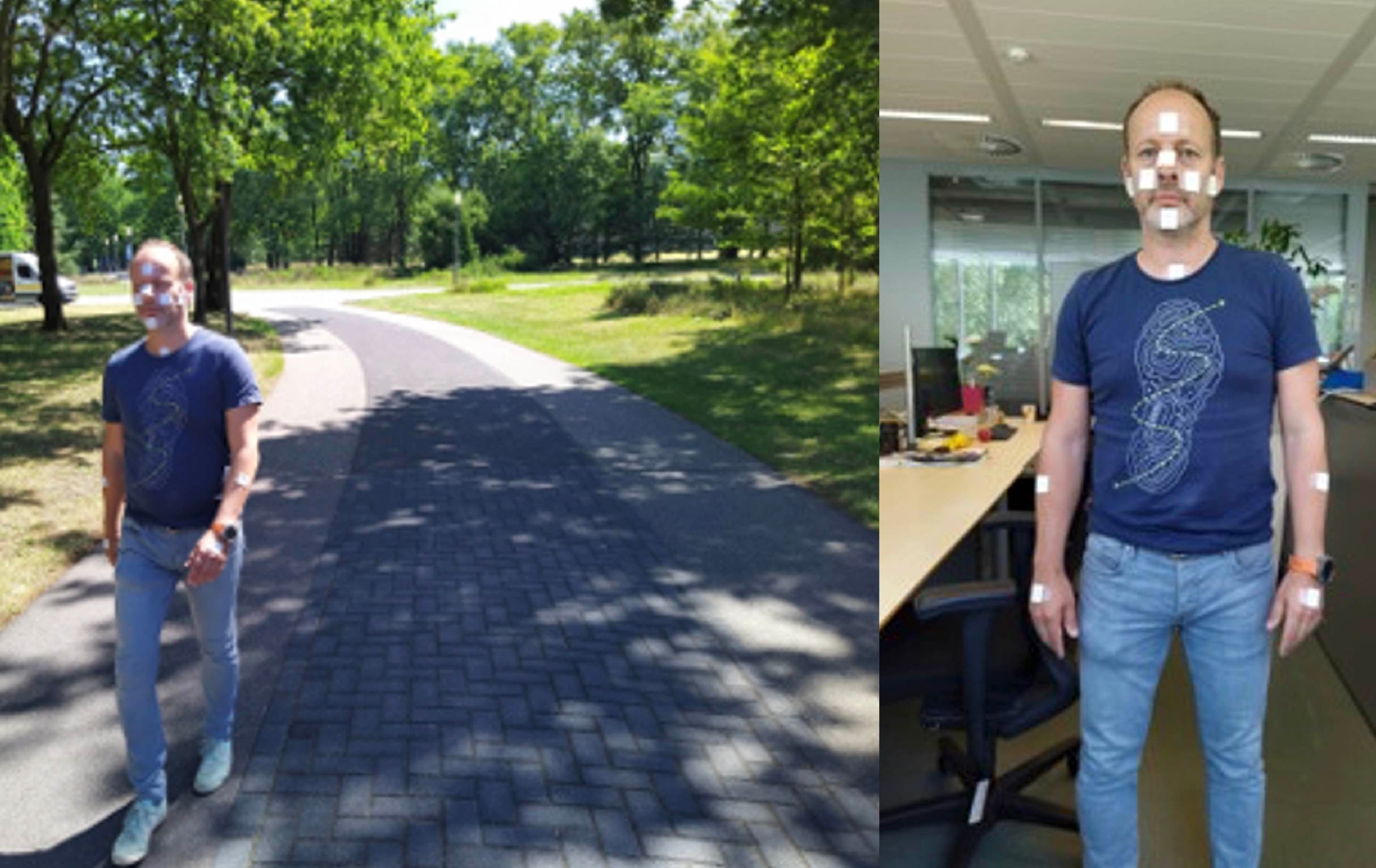
Next, we validated the simulations by measuring actual UV exposure on regular walks during a year in Eindhoven (around 51° latitude). Polysulphone patches were used on the hands and underarms, and on the face (chin, nose, cheeks, forehead) during these walks (Figure 6). These patches are in fact wearable dosimeters to measure cumulative UV radiation exposure and were obtained through the group of Prof. Ann Webb (Manchester University). Unlike consumer stickers that change color instantly, these polysulphone patches require laboratory analysis. The amount of UV received is determined by measuring the patch's absorbance at 330 nm using an UV-VIS Edinburgh spectral device before and after UV exposure (the decrease in absorption is a measure for the UV dose).
Figure 6. Measuring UV exposure using polysulphone patches (on the face, hands and lower arms) during a 15 min walk around noon (Eindhoven). From laboratory analysis of the patches, it is determined what the accumulated UV dose is.
Figure 7. Comparison of measured and simulated SED values from 15-minute walks at noon across a year.
In Figure 7 we show the measured SED (body-surface weighted average from the different patches) across a full year as derived from analyses of the polysulphone patches together with the simulations. It shows a very good resemblance between the average measurements and the simulation (Eindhoven is at 51.4° latitude, simulation is at 50°).
From Recommended Exposure to Low-dose Application
The average dose from a single 15-minute outdoor walk exposure is 0.28 SED. This number is obtained by averaging across the period April-September, and then correcting for the fact that between 10:00-15:00h the average solar irradiance is around 0.83 (with normalized value of 1 at 12:00h). The recommended weekly dose then is 2-3 times 0.28 SED, or 2.5 x 0.28 = 0.70 SED. If we want to deliver this weekly dose via UVB-enhanced light during office hours of a 5-day workweek, we arrive at a daily dose of 0.70 / 5 = 0.14 SED. This is exactly the daily dose received in a clinical trial described below.
Proof of Effectiveness from a Clinical Trial
The effectivity of an ultra low dose UVB was tested in a clinical trial in the UK [26] during wintertime, when sunlight is too weak to support natural vitamin D production. From mid-October 2021 and March 2022 (20 weeks) a double blind randomized clinical trial with office workers in the Sunderland Hospital was conducted. Ten participants used standard desk lamps whereas another ten participants used modified versions of the lamps that contained additional LEDs that emitted ultra low levels of UVB (Figure 8). Participants used the lamps during normal working hours, and their vitamin D levels were measured regularly. The UV exposure was extremely low and carefully designed to stay well within established safety limits. The average daily received exposure was 0.14 SED within an 8-hour working day. Results showed that participants using the UV enhanced lighting experienced a statistically significant improvement in vitamin D levels compared to those using regular lighting. Specifically, the UV group had about a 7 nmol/L higher vitamin D level after 8 weeks compared to the control group. It meaningfully reduced the usual seasonal drop in vitamin D seen during winter, over the 8-week test period.
Importantly, interviews with the participants after the study period revealed that the lighting was well tolerated. No adverse effects of the lighting were reported; on the contrary participants welcomed the additional lighting and even mentioned to prefer lighting above supplements (as it means they wouldn’t forget to take them). Overall, the study demonstrates that integrating very low levels of UVB into everyday indoor lighting is a promising, practical way to support vitamin D levels during periods of low sunlight. This approach could offer a convenient alternative or complement to supplements, particularly for people with limited outdoor exposure.
Figure 8. Floor lamp providing white light at the desk, modified with LEDs emitting ultra-low levels of UVB.
Photobiological Safety
Light sources and luminaires need to comply with the photobiological safety standards [27]. For the UVB part, it requires to be compliant with the actinic irradiance requirements in accordance with IEC 62471. For a risk group 0 (exempt) classification the actinic weighted irradiance should be below 1 mW/m2. The defined exposure dose of 0.14 SED can be achieved, while remaining below the Risk Group 0 irradiance and exposure limits within normal (ceiling) use, making the application and luminaires safe to use. The knowledge has been applied to a specially designed UVB accessory from Signify: Philips VitaUp.
VitaUp Module
The above-described background research and analysis have led to the development of the Philips VitaUp module, containing UVB emitting LEDs. The module can be used as standalone (Figure 9). A grid of modules can be realized in an office space providing a uniform coverage within the room or can be implemented in a luminaire. Also, the module can be programmed to provide a circadian day profile. Sunlight UVR is naturally only available during daytime, not during the evening and night, so it makes sense to have a circadian profile in sync with nature.
Figure 9. Left: The VitaUp module as standalone solution (upper picture) and the VitaUp module for luminaire integration (lower picture). Right: Optical simulation of a 3x6 grid of modules in an office space, showing uniform coverage at the desk level.
In Figure 10 the emission spectrum of the VitaUp module is shown. It is designed to co-align with the up flank of the natural UVB emission of outdoor sunlight, while at the same time having spectral overlap with the action spectrum of pre-vitamin D, as defined by CIE [28].
Figure 10. Normalized intensities of the pre-vitamin D (7-DHC) action spectrum (red line) as defined in CIE 2006 [28], summer daylight irradiance (green line), and the spectral emission of the VitaUp UVB LED (blue line).
Figure 11 shows two examples of luminaire architectures from Signify and Regiolux with an integrated Philips VitaUp module.
Figure 11. Two examples of integration of the VitaUp UVB module. Left: Philips Skylight with VitaUp module in the rim. Right: Regiolux Tirabo LumiD3 with the VitaUp module in the centre of the light emitting area.
Final Remark
Recently, a group of international experts reviewed the latest scientific evidence on the health benefits of sunlight and ultraviolet radiation (UVR), particularly benefits that are not explained by vitamin D production alone [23]. Their review included findings from large population studies and a wide range of medical research. The experts noted that people who receive more sunlight exposure generally tend to have a longer life expectancy and a lower risk of several diseases. Growing evidence suggests that UVR may help prevent or improve certain health conditions, especially those involving inflammation and immune-system dysfunction. Based on the available scientific evidence, they concluded that the potential health benefits of sunlight deserve greater consideration in public health recommendations, and that preventive measures of natural and artificial UVB exposure might be a consideration. In addition to supporting the body's internal clock and vitamin D production, the UVB component of natural sunlight may offer health and well-being benefits that are largely absent from modern indoor environments. As people today spend most of their time indoors, incorporating selected beneficial aspects of natural sunlight into indoor spaces could represent a new and innovative approach to supporting human health and well-being.
References
- Rapf, R. J., & Vaida, V. (2016). Sunlight as an energetic driver in the synthesis of molecules necessary for life. Physical Chemistry Chemical Physics, 18(30), 20067-20084.
- Hessen, D. O. (2008). Solar radiation and the evolution of life. Solar radiation and human health, 123-136.
- Klepeis, N. E., Nelson, W. C., Ott, W. R., Robinson, J. P., Tsang, A. M., Switzer, P., ... & Engelmann, W. H. (2001). The National Human Activity Pattern Survey (NHAPS): a resource for assessing exposure to environmental pollutants. Journal of Exposure Science & Environmental Epidemiology, 11(3), 231-252.
- Cui A, Zhang T, Xiao P, Fan Z, Wang H and Zhuang Y (2023) Global and regional prevalence of vitamin D deficiency in population-based studies from 2000 to 2022: A pooled analysis of 7.9 million participants. Front. Nutr. 10:1070808. doi: 10.3389/fnut.2023.1070808
- Curtis, F. (2015). The role of Vitamin D and physical activity in glycaemic homeostasis (Doctoral dissertation, Aberystwyth University).
- Lerche, C. M., Philipsen, P. A., & Wulf, H. C. (2017). UVR: sun, lamps, pigmentation and vitamin D. Photochemical & Photobiological Sciences, 16(3), 291-301.
- Nair, R., & Maseeh, A. (2012). Vitamin D: The “sunshine” vitamin. Journal of pharmacology & pharmacotherapeutics, 3(2), 118.
- Mead, M. N. (2008). Benefits of sunlight: a bright spot for human health.
- Diffey, B. (2015). Solar spectral irradiance and summary outputs using excel. Photochemistry and photobiology, 91(3), 553-557.
- Engelsen, O. (2010). The relationship between ultraviolet radiation exposure and vitamin D status. Nutrients, 2(5), 482-495.
- Orte, P. F., Wolfram, E. A., Salvador, J., D'Elia, R., Leme, N. P., & Quel, E. J. (2011, January). Synthesis of vitamin D and erythemal irradiance obtained with a multiband filter radiometer and annual variation analysis in Río Gallegos, Argentina. In Journal of Physics-Conference Series (Vol. 274, No. 1, p. 012099).
- Kazantzidis, A., Bais, A. F., Zempila, M. M., Kazadzis, S., Peter, N., Koskela, T., & Slaper, H. (2009). Calculations of the human vitamin D exposure from UV spectral measurements at three European stations. Photochemical & Photobiological Sciences, 8(1), 45-51.
- Reichrath, J. (2006). The challenge resulting from positive and negative effects of sunlight: how much solar UV exposure is appropriate to balance between risks of vitamin D deficiency and skin cancer?. Progress in biophysics and molecular biology, 92(1), 9-16.
- Ginde AA, Liu MC, Camargo CA Jr. Demographic Differences and Trends of Vitamin D Insufficiency in the US Population, 1988-2004. Arch Intern Med. 2009 Mar 23; 169(6):626-32.
- Itoh, M., Tomio, J., Toyokawa, S., Tamura, M., Isojima, T., Kitanaka, S., & Kobayashi, Y. (2017). Vitamin D–Deficient Rickets in Japan. Global Pediatric Health, 4, 2333794X17711342.
- Goldacre, M., Hospitalisation for children with rickets in England: a historical perspective, The Lancet, Correspondence Volume 383, Issue 9917, P597-598, FEB 15, 2014.
- Joshi, P., Martin, S., Blaha, M., McEvoy, J., Santos, R., Cannon, C., ... & Jones, S. (2014). Seasonal Variations in lipid profiles from 2.8 million US adults: the very large database of lipids (VLDL 14). Journal of the American College of Cardiology, 63(12S), A1458-A1458.
- Patwardhan, V. G., Khadilkar, A. V., Chiplonkar, S. A., Mughal, Z. M., & Khadilkar, V. V. (2015). Varying relationship between 25-hydroxy-vitamin D, high density lipoprotein cholesterol, and serum 7-dehydrocholesterol reductase with sunlight exposure. Journal of clinical lipidology, 9(5), 652-657.
- Slominski, A. T., Chaiprasongsuk, A., Janjetovic, Z., Kim, T. K., Stefan, J., Slominski, R. M., ... & Tuckey, R. C. (2020). Photoprotective properties of vitamin D and lumisterol hydroxyderivatives. Cell biochemistry and biophysics, 78(2), 165-180.
- Norval, M., Björn, L. O., & de Gruijl, F. R. (2010). Is the action spectrum for the UV-induced production of previtamin D3 in human skin correct?. Photochemical & Photobiological Sciences, 9(1), 11-17.
- Duchow, E. G., Duchow, M. W., Plum, L. A., & DeLuca, H. F. (2021). Vitamin D binding protein greatly improves bioactivity but is not essential for orally administered vitamin D. Physiological Reports, 9(23), e15138.
- Lucas, R., McMichael, T., Smith, W. & Amstrong, B. Solar ultraviolet radiation: global burden of disease from solar ultraviolet radiation, World Health, 55 (2006), pp. 987-999.
- Riedmann, U., Dibben, C., de Gruijl, F.R. et al. Beneficial health effects of ultraviolet radiation: expert review and conference report. Photochem Photobiol Sci 24, 867–893 (2025). https://doi.org/10.1007/s43630-025-00743-6
- Grant, W. B., Lahore, H., McDonnell, S. L., Baggerly, C. A., French, C. B., Aliano, J. L., & Bhattoa, H. P. (2020). Evidence that vitamin D supplementation could reduce risk of influenza and COVID-19 infections and deaths. Nutrients, 12(4), 988.
- Int. Organization for Standardization/Commission Internationale de l’Eclairage (1999) Joint ISO/CIE Standard: Erythema Reference Action Spectrum and Standard Erythema Dose. ISO 17166/CIE S007/E-1999. CIE Central Bureau, Vienna, Austria.
- Webb, A. R., van der Zande, B. M., Kift, R. C., O’NEIL, H. E. L. E. N., Lin, N. X., & Wright, D. (2022). Ultra-low ultraviolet radiation in office lighting can moderate seasonal vitamin D cycle: a pilot study. Anticancer Research, 42(10), 5101-5106.
- IEC 62471. (2006). Photobiological safety of lamps and lamp systems.
- CIE (International Commission on Illumination) (2006) Action spectrum for the production of previtamin D3 in human skin. Publication No. CIE 174
About the Authors
Ir. Rémy C. Broersma is principal scientist in the field of lighting applications. He started in 1998 at Philips Lighting (now Signify) and has a background in Chemistry and Health Science. His work focuses on translating scientific insights into practical solutions that advance sustainable and Human Centric Lighting technologies. He drives opportunities in lighting applications beyond traditional illumination.
Dr. Ir. Marcel P. Lucassen is senior scientist in the field of Light & Vision. He holds a PhD in biophysics (on color constancy) from Utrecht University. Before joining Signify, he worked at several corporate and academic institutes, as well as in self-employment, specializing in color science and visual perception. In Signify Research he has been working on topics around Quality of Light and Human Centric Lighting, the last years with the emphasis on non-visual aspects of light, supporting Health and Wellbeing propositions.