
Human-centric Lighting
CIE Calls for Focused Research Efforts to Support Healthful Lighting Recommendations
Not so long ago, vision scientists thought that light detection - photoreception - was exclusively performed by rod and cone cells in the retina. Photobiologists, however, conclusively demonstrated otherwise with the identification of the intrinsically photoreceptive retinal ganglion cells…
Published by LED professional ·
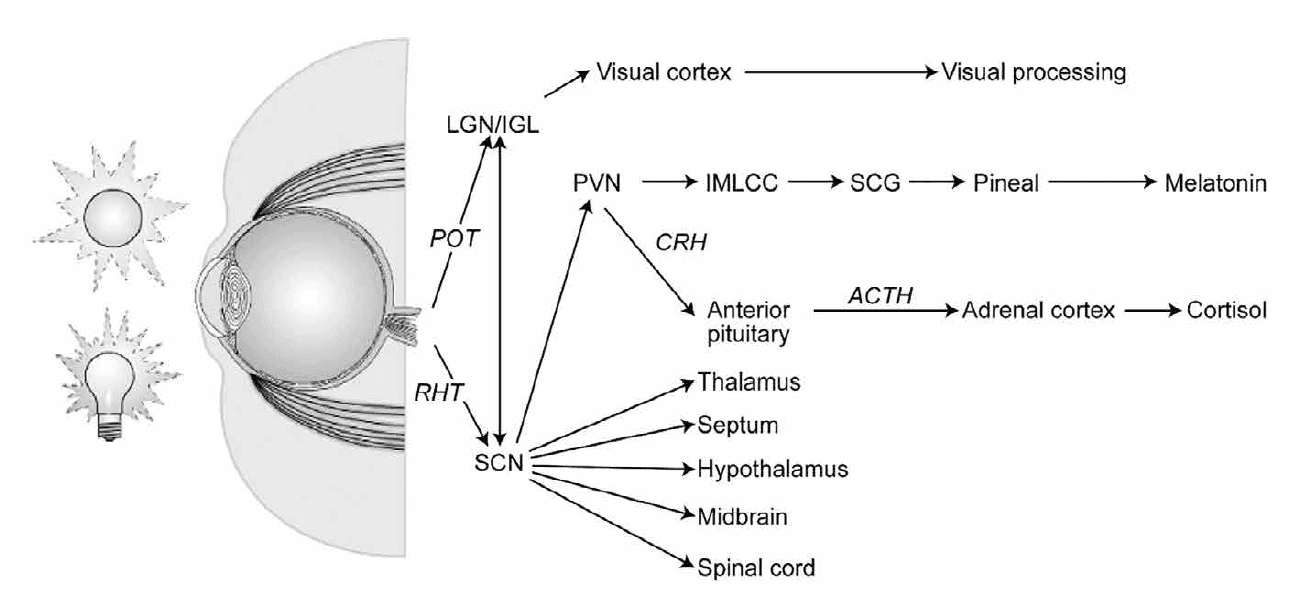
The CIE published the first consensus report about the physiological and behavioral effects of ocular light exposure in 2004 [2], establishing five principles of healthy lighting that remain valid with current knowledge.
Figure 1: The Schematic diagram of eye-brain pathways (2). Light received by the eye is converted to neural signals that pass via the optic nerve to two pathways, one visual and one non-visual.
POT = Primary optic tract
RHT = Retino-hypothalamic tract
LGN/IGL = Intergeniculate leaflet of the lateral
geniculate nucleus of the hypothalamus
SCN = Suprachiasmatic nucleus of the
hypothalamus
PVN = Paraventricular nucleus of the
hypothalamus
IMLCC = Intermediolateral cell column
SCG = Superior cervical ganglion
CRH = Corticotropic releasing hormone
ACTH = adrenocorticotropic hormone
The five principles of healthy lighting:
• The daily light dose received by people in Western (industrialized) countries might be too low
• Healthy light is inextricably linked to healthy darkness
• Light for biological action should be rich in the regions of the spectrum to which the non-visual system is most sensitive
• The important consideration in determining light dose is the light received at the eye, both directly from the light source and reflected off
surrounding surfaces
• The timing of light exposure influences the effects of the dose
The potential to use light to benefit well-being is huge, and excitement to do so quickly is high. However, alongside the possible benefits also come risks. Acting on imperfect knowledge, it is possible to cause unintended harm. The CIE, therefore, continues to call upon researchers to provide more and better knowledge that can serve as a strong foundation for the next generation of guidance and standards, while also providing tools and collegial opportunities to aid them in that work.
The identification of ipRGCs sparked a dramatic increase in photobiology and psychology research, especially among investigators of circadian regulation. In parallel there have been recurring calls for international bodies like the CIE to establish more detailed guidance concerning how we can use light exposure to benefit health and well-being. The CIE responded in 2004 and 2006 by holding expert symposia, and in 2007 and in 2011 convening workshops at CIE Quadrennial Sessions, to bring together the multidisciplinary communities of researchers with an aim to develop consensus.
One of the barriers to consensus has been the need for a new quantity with which to characterize this light exposure. The lumen is irradiance weighted by the visual spectral sensitivity function, Vλ. This is the wrong quantity to use for characterizing the dose received by the ipRGCs, because they respond differently than do the cones, which are the basis for photopic vision. Indeed, the demonstration that melatonin suppression followed a different spectral sensitivity than the rods or cones was part of the logic leading to the identification of the ipRGCs. When several researchers had proposed slightly differing spectral sensitivity functions for the ipRGCs, CIE supported an expert workshop, attended by the key researchers in that field, at which the group developed the first consensus-based action spectra for the five known photoreceptor types (ipRGCs, rods, and the short-, medium- and long-wavelength cones) [3, 5]. The CIE report of the workshop, which is freely available from the CIE Website, includes an Excel toolbox with which to calculate for any spectrum the light dose received by each cell type in SI units.
Why is this important? Without such a tool, it is impossible to compare research papers in terms of the dose-response relationship, especially when researchers are inconsistent about reporting the spectral power distribution of the light sources used in their studies (indeed, sometimes inconsistent in reporting any details at all about the light source). If we do not know what light exposure or total dose was received, we cannot judge whether two papers are consistent or not in finding the same effects. In order to further advance the effort to improve communication about these effects, as well as to provide a foundation for future guidance and application standards, CIE JTC 9 is currently engaged in the development of a standard for the action spectrum for this new quantity.
The toolbox, together with the standardization of the action spectrum, will be the departure point for a new research era in the field of healthful lighting, one in which it is possible to build a clear understanding of the answers to questions (right fact box).
These are a small selection of the full research agenda that the CIE has placed as an inspiration and a challenge to the research community [4]. The answers are urgently needed, not only to address the hunger for integrative lighting solutions and methods to deliver what some have called “human-centric lighting”, but also to resolve the inherent tension between those who seek to deliver a higher daily light dose for well-being, and those who seek to use less energy for electric lighting. By highlighting this field, in its 2016 Research Strategy, the CIE seeks to focus attention on developing the information the world awaits, so that everyone can enjoy the proper light at the proper time.
Some questions being answered:
• What pattern of daily light and dark exposure (intensity, spectrum, timing,
duration) best supports well-being, both for circadian regulation and acute effects during waking hours (e.g. alertness, emotion, social behavior)? How does this vary throughout life, from infancy to old age?
• In addition to circadian regulation, what physiological and psychological processes are influenced by ocular light detection?
• There are known medical uses of light to treat certain skin disorders and hyperbilirubinemia. There is speculation that inadequate light exposure during childhood contributes to the development of myopia. These ideas lead to the general question: Are there behavioral or physiological effects of extra-ocular absorption of optical radiation that should influence lighting recommendations?
References:
[1] D.M. Berson, F.A. Dunn and M. Takao, 2002. Phototransduction by retinal ganglion cells that set the circadian clock. Science, 295(5557), 1070-1073.
[2] CIE. 2004/2009. Ocular lighting effects on human physiology and behaviour (CIE 158:2009).
[3] CIE. 2015. Report on the First International Workshop on Circadian and Neurophysiological Photometry, 2013 (CIE TN 003:2015).
[4] CIE. 2016. Research roadmap for healthful interior lighting applications (CIE 218:2016).
[5] R.J. Lucas, S.N. Peirson, D.M. Berson, T. Brown, H.M. Cooper, C.A. Czeisler, M.G. Figueiro, P.D. Gamlin, S.W. Lockley, J.B. O'Hagan, L.L.A. Price, I. Provencio, D.J. Skene and G.C. Brainard, 2014. Measuring and using light in the melanopsin age. Trends in Neurosciences, 37(1), 1-9
(c) Luger Research e.U. - 2017




