
Human-centric Lighting
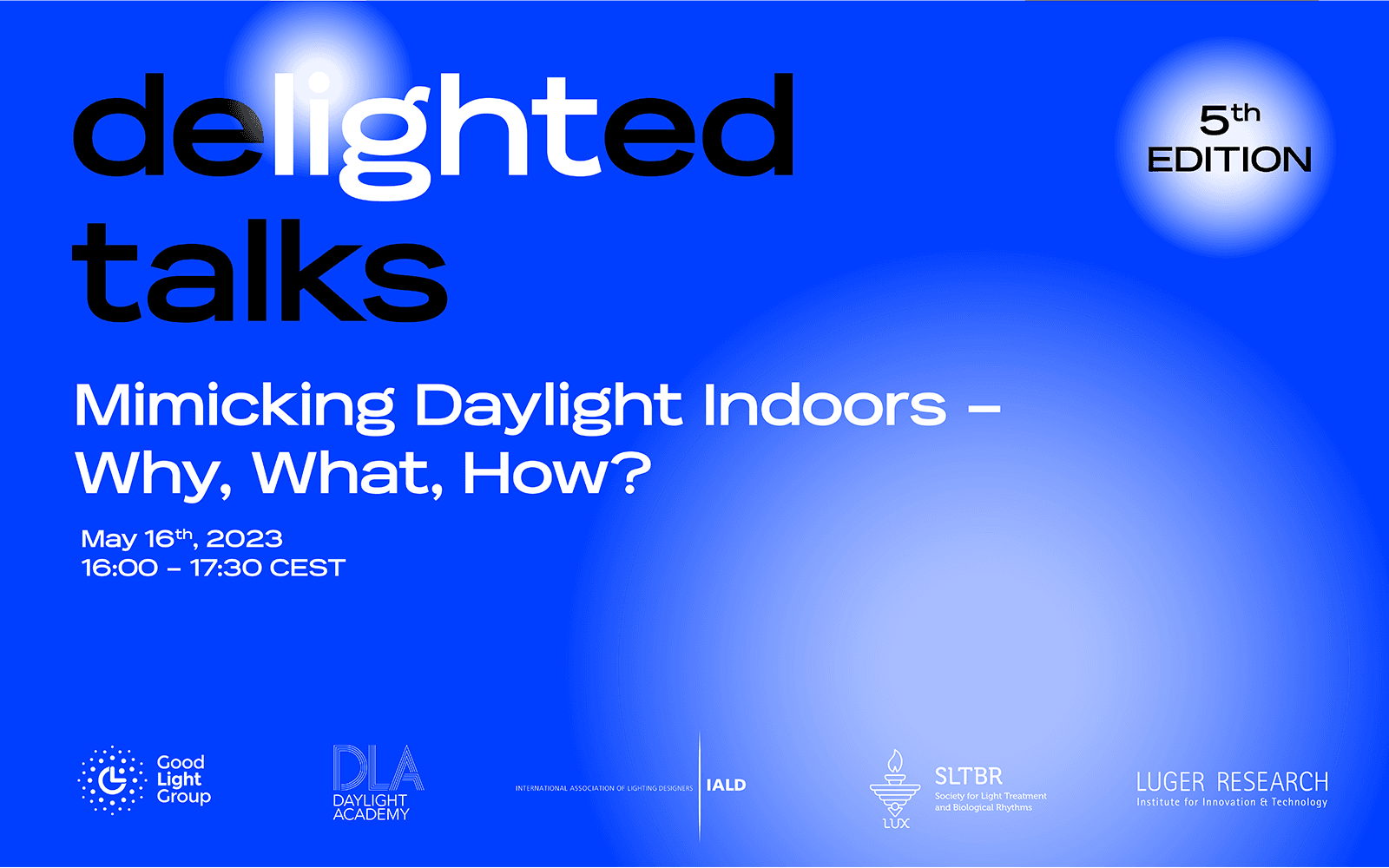
Webinar: Mimicking Daylight Indoors – Why, What, How?
The Good Light Group, together with the Society for Light Treatment and Biological Rhythms (SLTBR), the Daylight Academy (DLA), the International Association of Lighting Designers (IALD), and Luger Research (LR), are organizing and presenting the “Mimicking Daylight Indoors – Why, What, How?”…
Published by LED professional ·
This webinar will take place as part of UNESCO’s International Day of Light 2023 event.
May 16th, 2023 from 04:00 PM - 05:30 PM (CEST)
View the Recorded Webinar
Moderation
Aicha Diakite-Kortlever is a researcher and lighting engineer working in the field of daylighting, sustainable urban planning and environmental modelling. Aicha is currently working at the Department of Lighting Technology at the Technical University of Berlin as Lecturer and at the Vrije Universiteit Brussels as Guest Professor. She has received several awards for her work including the H.-J.-Helwig-Prize 2014 by the German Lighting Technology Association, the Hans-Peter-Willumeit-Award by the Foundation Committee of the Center of Human-Machine Systems (ZMMS), the Clara-von-Simson-Prize honouring women in science and engineering by the Technical University of Berlin, and the VDI Recognition by the Association of German Engineers.
Lecture: “Daylight – See Me, Feel Me, Touch Me, Heal Me!“
by Professor Yvonne de Kort, Technical University Eindhoven, The Netherlands
Abstract: Our technological tools to create indoor electric light are ever advancing, and yet in virtually every context there seems to be nothing better than “the real thing”. In my presentation I will review the scientific evidence for the importance of daylight and sunlight indoors for human health and wellbeing, and the different mechanisms through which these effects (may) emerge. We hope this may inspire architects and engineers to design for even better daylight access and perhaps even better electric lighting solutions.
Yvonne de Kort is a Full Professor and Chair of Environmental Psychology of Human-Technology Interaction in the Department of Industrial Engineering and Innovation Sciences at Eindhoven University of Technology (TU/e). With her group, she investigates the effects of lighting conditions on human functioning (e.g., alertness, stress, sleep, and health), specifically targeting light effects for day-active people in real-world conditions. This explicitly includes both visual effects and circadian and acute effects beyond vision, via our biological clock and neural regions related to alertness and mood. The research brings together insights from psychology, chronobiology, and neuroscience and aims to translate fundamental insights in human responses to light to implications for the design of environments, lighting scenarios, and intelligent lighting solutions. Additional research topics include the restorative and invigorating effects of light and nature scenes. Yvonne manages the interdepartmental Sound Lighting research program in TU/e’s Intelligent Lighting Institute and the Mental Health program in TU/e’s Center for Humans and Technology. She coordinates national and European projects, among which the European Training Network LIGHTCAP, under the Marie Skłodowska-Curie ITN framework.
Lecture: “Daylight in Buildings – How Much We Need and Get”
by Johannes Zauner, PhD, Munich University of Applied Sciences, Germany
Abstract: Designing spaces with optimal daylight levels is crucial for maintaining a healthy circadian rhythm. However, the typical indoor environment falls short of recommended (day)light levels for optimal health. In this talk, the speaker will showcase real-world projects that successfully optimized daylight levels during the design phase and integrated artificial lighting to boost light levels during winter. Attendees will gain insights into why quantitative daylight optimization at the very beginning of a project saves money and leads to better interior spaces.
Johannes Zauner works as a researcher and lecturer in the field of "Light and Health" at Munich University of Applied Sciences, having completed his PhD in Human Biology. After his apprenticeship in architectural drafting, he studied Interior Design and Architecture, and worked as a freelance planner as well as in research on energy-efficient buildings, daylighting and artificial lighting. Inspired by a pilot project in the field of "Light and Health" with the German Federal Environmental Foundation (DBU), he shifted his research focus to study the effects of light on humans. As a freelance partner of the Munich lighting design and engineering firm 3lpi he incorporates his studies into planning practice. Johannes Zauner is a member and spokesperson for the technical-scientific committee (TWA) of the German Lighting Technology Society (LiTG) for melanopic light effects, as well as a member of the Expert Forum for Interior Lighting (EFI).
Panel Discussion
with Kai Broszio, Aicha Diakite-Kortlever, Yvonne de Kort, Johannes Zauner
Kai Broszio works as a research associate at the German Federal Institute for Occupational Safety and Health (BAuA). Here, he focuses on non-visual effects of light at the workplace. His doctoral research at the lighting technology research group of the TU Berlin investigates the effects of the direction of light incidence on non-visual effects of light on humans. He was guest editor for the Journal of Environmental Psychology and reviewer for various international scientific journals. Additionally, he teaches lighting technology as a lecturer at the University of Applied Sciences (HTW) Berlin. Kai Broszio is active in committees of the CIE, the DIN Standards Committee for Lighting Technology and the German Lighting Technology Society (LiTG).




