
Testing
VCSEL Array Polarization and LIV+λ Measurement
VCSEL array characterization – Learn all about one-shot and single-emitter-resolved polarization and LIV+λ measurements! We extend LIV+λ measurements to individual emitters within a VCSEL array, thereby incorporating polarization measurements. To assess the characteristics of the VCSEL array in…
Published by LED professional ·
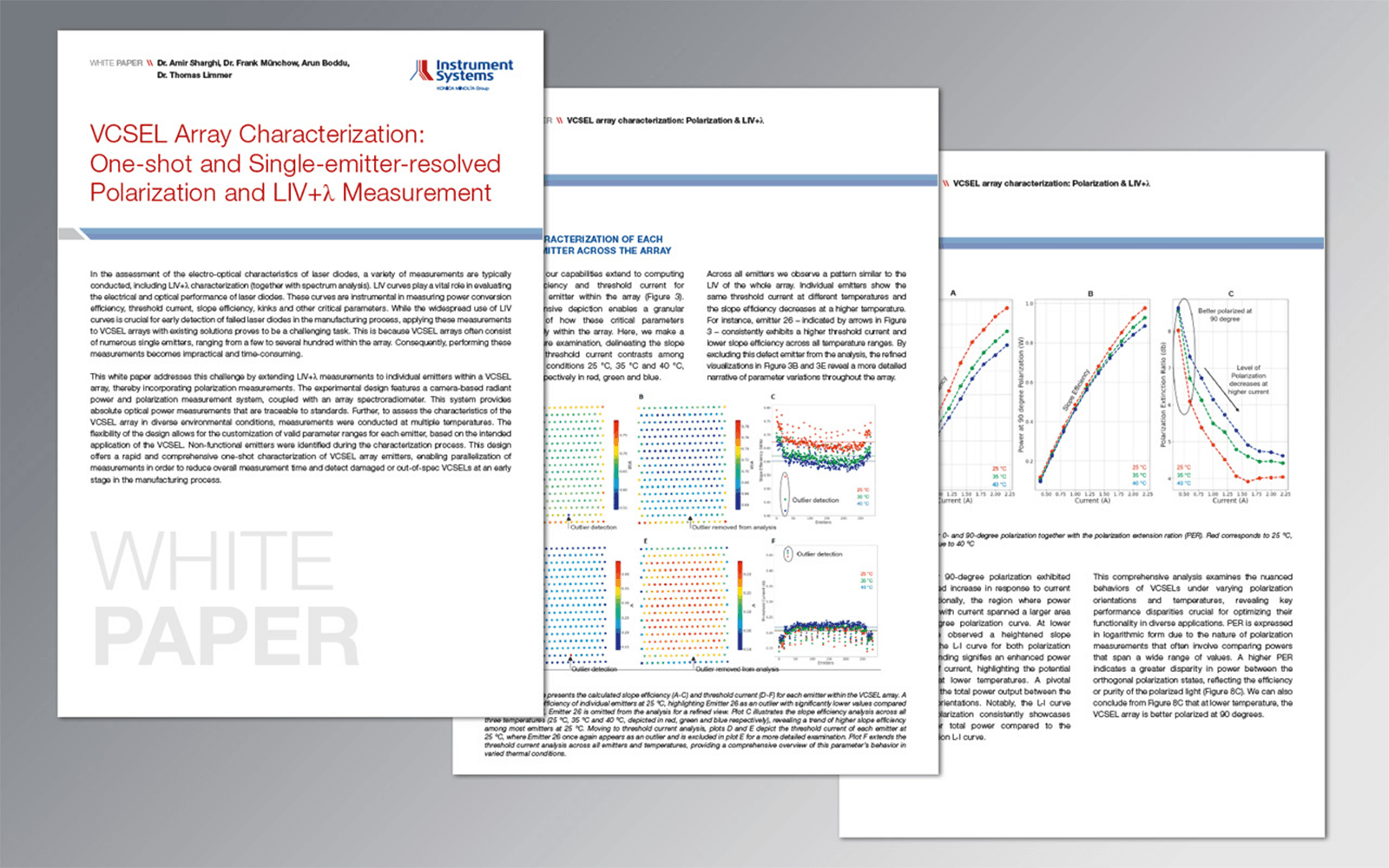
In the assessment of the electro-optical characteristics of laser diodes, a variety of measurements are typically conducted, including LIV+λ characterization (together with spectrum analysis). LIV curves play a vital role in evaluating the electrical and optical performance of laser diodes. These curves are instrumental in measuring power conversion efficiency, threshold current, slope efficiency, kinks and other critical parameters. While the widespread use of LIV curves is crucial for early detection of failed laser diodes in the manufacturing process, applying these measurements to VCSEL arrays with existing solutions proves to be a challenging task. This is because VCSEL arrays often consist of numerous single emitters, ranging from a few to several hundred within the array. Consequently, performing these measurements becomes impractical and time-consuming.
This white paper addresses this challenge by extending LIV+λ measurements to individual emitters within a VCSEL array, thereby incorporating polarization measurements. The experimental design features a camera-based radiant power and polarization measurement system, coupled with an array spectroradiometer. This system provides absolute optical power measurements that are traceable to standards. Further, to assess the characteristics of the VCSEL array in diverse environmental conditions, measurements were conducted at multiple temperatures. The flexibility of the design allows for the customization of valid parameter ranges for each emitter, based on the intended application of the VCSEL. Non-functional emitters were identified during the characterization process. This design offers a rapid and comprehensive one-shot characterization of VCSEL array emitters, enabling parallelization of measurements in order to reduce overall measurement time and detect damaged or out-of-spec VCSELs at an early stage in the manufacturing process.
White Paper Content:
- Detailed VCSEL characterization relevant for e.g. facial recognition, 3D sensing, incabin sensing, and LiDAR
- The criticality of polarization measurements for each emitter
- The necessity to establish precise criteria for acceptable measurement deviations
- How to identify underperforming or out-of-specification emitters
– Download White Paper –
VCSEL Array Characterization: One-shot and Single-emitter-resolved Polarization and LIV+λ Measurement
Authors: Dr. Amir Sharghi, Dr. Frank Münchow, Arun Buddu, Dr. Thomas Limmer
Pages: 10, Copyrights 2024
Sponsored by Instrument Systems
www.instrumentsystems.com




