
Testing
LightMtrX Light Metrology Software Platform
Labsphere is the first in the industry to develop commercially viable light test application software, proving its leadership with LightMtrX. LightMtrX software sets the pace for next generation light measurement software in response to your particular needs.
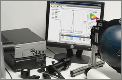
Application solutions are available for controlling Labsphere’s line of CDS spectrometers and LSA 3000 LED Spectral Analyzers as well as auxiliary source meters and temperature controllers. The Windows® XP and Vista®-compliant application modules are designed specifically to optimize use of Labsphere’s light metrology products for R&D, QC and production applications.
LightMtrX-SPEC:
The MtrX-SPEC software module is the most intuitive platform for calibrating and analyzing spectral radiometric, photometric and colorimetric properties of light sources ranging from simple lamps and LEDs to solid state lighting assembles and traditional indoor and outdoor lighting systems.
LightMtrX-LSA:
The MtrX-LSA software module controls Labsphere’s LSA 3000 and auxiliary source meters and LED temperature controllers. MtrX-LSA application software provides complete control of the rotational stages and spatial radiation measurement routines. Controlled by the MtrX-LSA software the LSA 3000 performs accurate measurements of narrow-angled to broad distributing LEDs at a high angular resolution of 0.1 degree. The MtrX-LSA spatial software allows the user to measure and plot relative intensity versus user selectable polar angles. The report save options includes formats compatible with Tracepro and Optimax for far field spatial modeling. Enhancing the performance by adding Labsphere’s Condition B intensity head (I 1000), a CDS spectrometer, and MtrX-LSA software the LSA 3000 can be used to measure intensity and color at user selectable positions.
FEATURES:
Save time on the learning curve with methods driven operations
You don’t need to be a metrologist with LightMtrX’s intuitive calibration processes
Adhere to your quality management system with user calibration and validation processes.
Capture results instantly with real time graphics
Select the parameters you want to see and hide the rest
Display, log, and store results for research
Pass/Fail testing for production
Intensity profile polar plots for modeling and marketing
Spectral, electrical, and thermal control for complete characterization
Temporal plots for life performance
Windows Office® programs compatible
MEASURING:
Total spectral flux (Watts/nm)
Total radiant fux (Watts)
Total luminous flux (lumens)
Spectral intensity (Watts/sr-nm)
Averaged luminous intensity (lumens/sr)
Averaged radiant intensity (Watts/sr)
Spectral irradiance (Watts/cm2-nm)
Irradiance (Watts/cm2-nm)
Illuminance
Dominant wavelength
Spectral purity
Correlated color temperature
Peak wavelength
Color rendering index (CRI)
Chromaticity coordinates
Correlated color temperature
Half-bandwidth
Spatial distribution
Electrical
Thermal
Temporal (W/s, lm/s, CCT/s…)
For more information, visit: www.labsphere.com ; e-mail: labsphere@labsphere.com




