Smart Lighting
Glamox lights Norway’s most sustainable university building
Glamox has supplied 1,778 connected LED luminaires for Professor Mørch’s House in Trondheim, an 11,000 sqm teaching and office building for more than 500 students and 450 staff of NTNU and SINTEF Ocean. The indoor and outdoor lighting, announced on 17 November 2026, supports the building’s BREEAM Outstanding sustainability rating and lets light zones follow users’ needs.
Norwegian lighting group Glamox published the following project report in the “News and stories” section of its website on 17 November 2026. The company names no individual author. LED professional reproduces the text with minor editorial adjustments.
Glamox has provided sustainable lighting for the Professor Mørch’s House building, part of the ambitious Norwegian Ocean Technology Centre campus in Trondheim. The Professor Mørch’s House building is setting a new standard for energy efficiency and environmental performance. Glamox has provided connected LED lighting that is highly energy-efficient and enables light zones tailored to the exact needs of students and staff.
A hub for ocean research, education and marine technology
Named after Hans R. Mørch, a pioneer of the ship model tank, the building honours the man who helped establish Norway’s reputation in marine technology research. Today, his legacy lives on in a world-leading hub for international ocean research, education, and the development of marine technologies.
Designed by Snøhetta and delivered by Statsbygg, the 11,000 sqm office and teaching building is home to more than 500 students and 450 staff from Norwegian University of Science and Technology (NTNU) and SINTEF Ocean. Students studying to become maritime engineers and researchers will learn in spaces that blend cutting-edge technology with top-tier sustainability credentials.
A classroom in Professor Mørch’s House. (Image: Glamox)
1,778 connected luminaires for a BREEAM Outstanding building
Glamox was selected to supply connected indoor and outdoor lighting for Professor Mørch’s House, totalling 1,778 luminaires. Sales engineer Vidar Tronsaune led the project for Glamox. The company’s contract is with GK, one of Scandinavia’s leading end-to-end technical contractors and service partners. The brief was clear: deliver a solution that supports the building’s BREEAM Outstanding certification, improves visual comfort, and minimises energy consumption.
“Lighting plays a crucial role in creating a healthy, inspiring environment for students and staff. With Glamox’s energy-efficient lighting, we have achieved both outstanding visual comfort and significant energy savings, supporting our ambition to set a new standard for sustainable university buildings.”
— Tom Erik Olsen, District Manager and Head of Professional Services for GK, Trøndelag
Luminaires for classrooms, corridors, social areas and outdoors
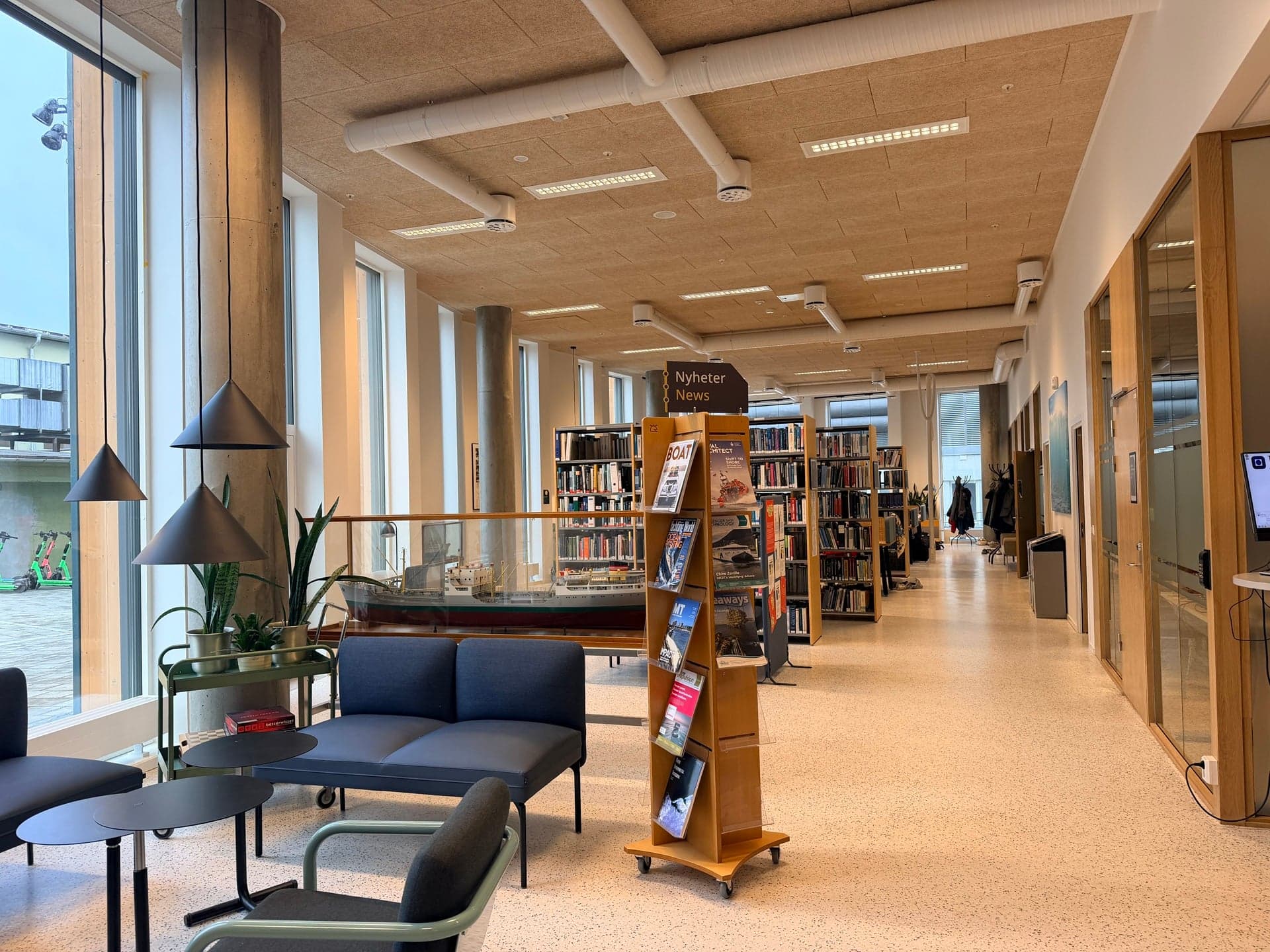
Classrooms and offices were fitted with Glamox C77 luminaires in recessed, surface-mounted, and suspended designs for optimal lighting. Corridors with acoustic ceilings featured custom C80-R fixtures for a seamless appearance. Social areas and the library gained character through decorative ALP fittings and S90 spotlights, while Luxo Trace lamps provided focused task lighting on selected desks. Outdoors, the project combined MIKO bollards, Glamox O55 wall and pole-mounted units, and O80 fixtures on rock walls and multi-masts for reliable illumination.
“From bright, glare-controlled study areas to welcoming circulation zones and safe outdoor spaces, every luminaire delivered in this project has played a role in creating an optimal environment for learning and collaboration. Lighting played a particularly crucial part in the library, auditorium, and social areas, where it was designed to create an inviting atmosphere, support concentration, and improve the overall experience of the spaces.”
— Knut Einar Askim, Sales Director in Glamox for Region North
The atrium of Professor Mørch’s House. (Image: Glamox)
Source: Glamox, “Glamox provides Norway’s most sustainable university building with connected lighting”, 17 November 2026.