Smart Lighting
Co-op Live: 23,500 seats, one intelligent DALI-2 platform
Co-op Live in Manchester, the UK's largest indoor arena with 23,500 seats, runs its lighting on a single DALI-2 control platform from Simmtronic. DALI-2 is the certified open standard for digital lighting control. The system links nearly 9,000 luminaires and over 800 control lines, automates emergency lighting tests and lets the show production system trigger lighting scenes during events.
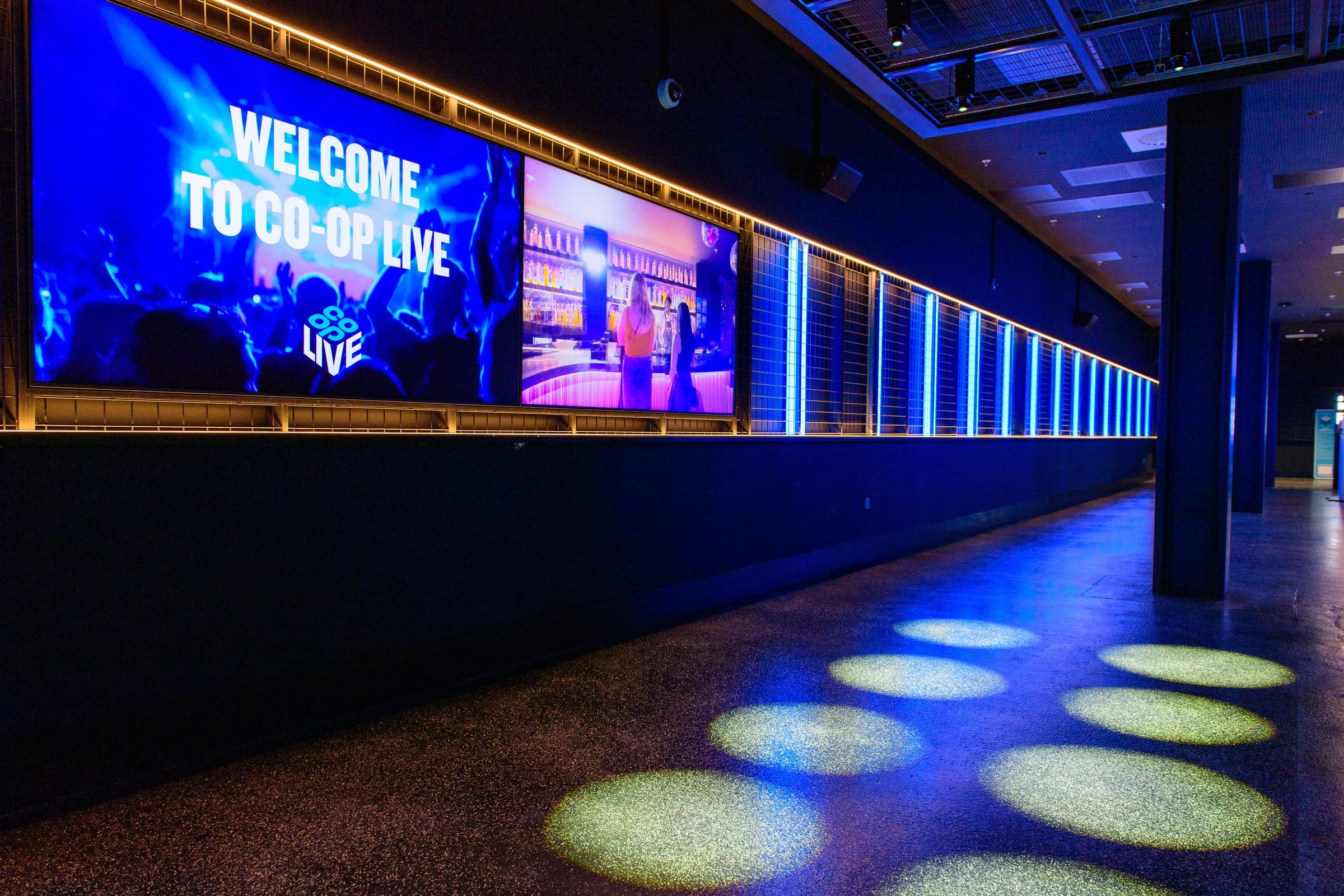
This project report by Simmtronic first appeared in LED professional Review (LpR) issue 115, May/June 2026, as part of the issue's DALI Focus.
When Co-op Live opened in Manchester, it became the UK's largest indoor arena, with a capacity of 23,500. It was designed from the outset to host some of the most demanding live entertainment productions in the country: major international touring acts, sporting events, corporate functions and hospitality services within a single, highly immersive environment.
For the lighting control infrastructure, the scale of the venue was only part of the challenge. The installed system comprises nearly 9000 luminaires, over 800 DALI-2 control lines and over 1500 input devices distributed across 33 IP Area Controllers. But the raw figures don't capture the operational complexity. A building of this type does not operate as a single space. It operates as dozens of them. Public concourses, artist corridors, hospitality suites, production zones, offices and back-of-house service areas each carry different operational requirements, different user expectations and different lighting behaviors. Some prioritize atmosphere and dynamic color. Others depend entirely on reliability and quiet automation. The control platform had to serve all of them through a single, coherent system.
This article describes how a DALI-2 control infrastructure delivered by Simmtronic supports day-to-day operation of the venue. It focuses on four operational themes: the Simmtronic Live Status Viewer as the true window into the system, supporting proactive maintenance and rapid configuration; automated emergency testing through integration with the venue's central battery infrastructure; BACnet integration that allows the venue's AV production environment to drive lighting during live events; and the dynamic color control infrastructure that supports artist corridors and other immersive spaces.
The Street, public concourse. (Image: Simmtronic / Jon Parker Lee Photography)
Why DALI for a venue of this complexity
DALI (Digital Addressable Lighting Interface) has, over the past two decades, become the most widely adopted protocol for commercial and architectural lighting control. Its strengths are well documented: each luminaire and control device on a DALI bus carries an individual address, and the protocol is supported across virtually every major lighting manufacturer.
The evolution of the standard into DALI-2 (IEC 62386) introduced several refinements that matter to a project of this complexity. The most significant is the independent certification program: devices carrying the DALI-2 mark must pass testing by an accredited body, providing a meaningful guarantee of cross-manufacturer interoperability.
At Co-op Live, the installed Lighting Control Modules are Simmtronic's DALI-2 compliant riser mounted Hardwired Hubs. Each has been independently tested and certified against the rigorous DALI-2 standard, which gives the project the assurance of full protocol compliance and reliable interoperability across the wider DALI ecosystem connected to it. The Simmtronic platform then supports these LCMs and the connected DALI devices throughout their operational life.
The versatility of the platform is one of its defining qualities. The same Simmtronic infrastructure that supports Co-op Live also operates across commercial offices like 22 Bishopsgate and The Scalpel, and across education environments like the University of Northampton. The system is not tied to a single building type. It is designed to be adaptable, scalable and suited to the operational reality of whatever environment it serves.
What matters most to a venue like Co-op Live is not the protocol version in isolation. It is what the protocol enables when combined with intelligent head-end software, well-designed input devices and a coherent commissioning approach: every luminaire individually addressable, every group and scene reconfigurable in software, feedback is reported through the same bus, and every change traceable through a single operational interface.
A single-master architecture
Across Co-op Live, day-to-day control of the luminaires originates from 33 IP Area Controllers distributed throughout the building. Each controller manages the lighting fed from its local distribution boards, communicating directly with the connected Lighting Control Modules, sensors and DALI infrastructure within its area. The intelligence is distributed: real-time control does not depend on a single central processor, and there is no single point of failure. If any one part of the network is interrupted, the rest of the system continues to function autonomously.
The Simmtronic SPC.3020 head-end sits above this distributed control layer as the operational window into the system. It is where the BACnet integration with the production AV environment is configured, where the SPN.200 automated emergency testing is managed, and where the Live Status Viewer brings operational and maintenance visibility together in a single interface.
The architecture has direct operational consequences. The facilities team manages one system, one interface and one point of oversight. External systems do not control lighting independently; they communicate with the Simmtronic platform through open protocols, including BACnet, DALI and volt-free contact inputs, and the Simmtronic platform interprets and executes the appropriate action. The behavior of every luminaire across the venue, regardless of area or function, remains consistent, auditable and manageable from a single platform.
Where multiple subsystems control lighting independently, even in well-engineered installations, the operational and maintenance burden quickly multiplies. Conflicts arise between automation rules, error diagnosis crosses system boundaries, and configuration changes ripple unpredictably. The single-master model avoids these issues by ensuring that all control authority sits in one place, while still allowing other systems to interact with lighting through well-defined integration interfaces. The lighting control infrastructure becomes a service that other systems use, rather than a peer they must coordinate with.
Proactive maintenance through the Live Status Viewer
In a venue running a considerable number of events per year across multiple spaces and seating configurations, maintenance has to be proactive. Comprehensive, real-time monitoring is the hallmark of a professionally instrumented installation: its value lies in giving the facilities team continuous confidence in the system and the ability to act early, so that routine maintenance is anticipated and handled quietly, before it is ever visible to anyone in the venue. Anything needing attention is identified by the system itself rather than waiting on an occupant to report it and is located precisely and presented to the maintenance team in a form that supports rapid resolution.
This is the role of the Simmtronic Live Status Viewer: an event-driven graphical interface that provides real-time visibility of every Simmtronic device and every DALI luminaire across the installation. The status of every device is surfaced in the Viewer as it changes, rather than requiring the engineer to poll the equipment.
The Viewer's central feature is automatic root cause analysis, which directs the engineer straight to the one item that needs attention rather than a long list to work through. Where a single underlying cause produces several knock-on symptoms (for instance, a bus communication issue affecting downstream devices) the system identifies the root cause and sets the secondary symptoms aside, so resolution is faster and more certain. Each item is accompanied by detailed guidance and a recommended remedial action.
For the facilities team at Co-op Live, this translates into several day-to-day capabilities:
- System status is visible at a glance. The Status Viewer presents the live status of the whole venue, color-coded against the floor plans, with a key explaining every symbol. Anything requiring attention can be filtered by area or floor.
- DALI bus topology is visible. The Viewer displays the physical connections between devices across the DALI buses, which helps maintenance teams locate cable breaks, loose connections and similar physical markers that would otherwise require significant time to diagnose.
- Inventory is comprehensive. The Viewer extracts and displays full inventory and configuration information from every DALI device on the system: manufacturer, model, serial number, firmware version and lamp run-hours, supporting both warranty management and proactive lamp replacement.
- History is replayable. The Head-End logs every event for every device, including presence detection, light output levels and photocell readings. The Viewer can recall and display full system status for any historical point since installation. This is useful for tracing causes of unexpected behavior or analysing occupancy patterns over time.
For Maintenance Engineers, the Live Status Viewer also functions as a configuration tool. Where an operations team member needs to adjust a scene level, perhaps to refine the look of a hospitality area or rebalance a concourse for a particular event configuration, they can do so through a simple graphical interface, selecting one or more luminaires and entering the required light level. Live levels can be set up, adjusted and captured as scenes for future recall.
Access to these tools is controlled through the SPECS Authentication, Authorisation and Accounting System. Engineers with appropriate training have access to the broader SPECS Manager environment, where complex configuration changes can be made. Day-to-day maintenance staff use a simpler subset of tools that supports the most common adjustments (preset scene levels, presence timeouts and similar settings) without exposing more sensitive configuration parameters.
The combination of system health monitoring, inventory management, history replay and easy adjustment in a single graphical interface means the venue's facilities team can perform the majority of operational tasks themselves, without external support. It is what makes the infrastructure operationally self-sufficient over the venue's long lifecycle.
Automated emergency testing through the SPN.200 system
Emergency lighting in a large public venue presents a difficult balance. Statutory testing under BS 5266 requires that every emergency luminaire be tested for both function and duration. In a venue like Co-op Live, where the building may be in use for events on any given day, those tests cannot disrupt occupants. More importantly, they must never compromise the safety of any area.
At Co-op Live, the emergency lighting is delivered through four Central Battery Units (CBUs) powering DALI-ballasted emergency luminaires. The Simmtronic SPN.200 Automatic Testing System integrates directly with the CBUs to manage testing, monitor system health and record the statutory testing regime.
The architecture is fundamentally fail-safe. In normal operation, each emergency luminaire is powered from the CBU and controlled by DALI commands from the lighting system. In the event of a power outage, the DALI line loses power and the DALI-compliant ballast automatically lights at its pre-configured emergency level, using mechanisms built into the DALI standard specifically for this purpose. No communication to the luminaire is required for emergency operation. This makes the emergency response inherently reliable: if anything in the lighting control chain is interrupted, whether an LCM, a DALI bus or the head-end itself, the emergency lighting still activates.
Because the DALI buses are powered from the local lighting circuit, there is no requirement for change-over relays at each emergency luminaire. The luminaires are fed from the CBU and the DALI ballast handles the transition to emergency operation autonomously. This single design decision delivered significant on-site savings in both equipment cost and installation labor. It also simplifies long-term maintenance: there are no individual change-over relays at each luminaire to fail or replace.
The SPN.200 system manages testing in three layers:
- Continuous monitoring. The ATS interrogates every DALI ballast continually. Ballast, wiring or lamp feedback is reported as soon as they are detected, rather than waiting for the next scheduled test. The CBU's own status indicators (system in operation, supply from battery, and battery charge state where available) are surfaced through the Live Status Viewer.
- Monthly function tests. The ATS commands the CBU to simulate a supply failure for a short period, sufficient to verify that every emergency luminaire lights correctly from battery power. Each ballast is individually interrogated to confirm it is responding and correctly lit. Function tests run automatically out of hours, with no walk-test requirement.
- Annual duration tests. A full three-hour discharge test on each CBU verifies that the battery can sustain the rated load for its declared duration. The ATS will only initiate a duration test once it has confirmed that the CBU is fully recharged and that an adequate proportion of luminaires are responding correctly.
The testing sequence is carefully ordered to protect building safety throughout. Before commanding a CBU to switch to battery supply, the ATS first verifies that every DALI ballast in the connected emergency luminaires is responding and correctly configured. If an inadequate proportion of luminaires are operational, the test is aborted before any battery discharge takes place, preventing unnecessary depletion of the batteries. Only when the system is confident the test will be valid does it command the CBU to switch to battery operation, verify each luminaire continues to light from the battery, and return everything to normal supply once the test is complete.
The practical consequences for Co-op Live are substantial:
- Coverage is 100%. Every emergency luminaire is tested, not just a sampled subset, and every test result is centrally logged.
- Record keeping is automatic. Test history for every luminaire and every CBU is recorded and available for inspection at any time. Test report summaries can be generated and printed on demand.
- Diagnostics are intelligent. The system distinguishes between ballast failures, lamp failures, battery and inverter queries, and presents a clear remedial action for each.
- Locations are shown graphically. Any item requiring attention is displayed with maintenance instructions that can be printed.
- Pre-emptive detection. Many defects are caught between formal tests through continuous ballast monitoring, rather than only being discovered at the next scheduled test.
The SPN.200 approach is highly integrated within the wider SPECS platform. Emergency lighting status appears in the same Live Status Viewer used for general feedback management, so an issue on an emergency luminaire is presented to the operator through the same interface as any other fault in the building.
For a venue with the public-facing safety profile of Co-op Live, the operational reassurance this provides is significant. The system delivers complete, automated, statutorily compliant testing without ever putting an area of the building at risk during a test cycle.
BACnet integration with the production AV environment
Modern entertainment venues operate with deep integration between their AV, lighting, building management and production systems. At Co-op Live, this integration was particularly important during live events, where the production team required the ability to manage lighting scenes and color environments directly from the production AV environment, without requiring an operator to be present at a Lighting Control interface during a show.
The Event Bowl with Simmtronic Live Viewer. (Image: Simmtronic / Jon Parker Lee Photography)
The integration is delivered through Simmtronic's BACnet interface, configured from the SPC.3020 head-end and forming part of the SPN.400 Data Exchange Suite. The BACnet interface exposes lighting system data and control points to other building and IT systems through a well-defined open standard, allowing external platforms to send control commands and to retrieve status information from the lighting infrastructure.
Architecturally, the integration follows the single-master principle. The production AV environment does not assume direct control of the lighting infrastructure. Instead, the AV system sends BACnet instructions to the Simmtronic head-end: change to this scene, set this group to this color, recall this preset. The Simmtronic platform interprets those instructions and executes the appropriate action on the lighting infrastructure. To the production engineer, the experience is seamless: scene changes happen on cue from the AV environment. But the lighting infrastructure remains under unified Simmtronic control throughout, with all activity logged through the Viewer and visible to the facilities team.
This approach has several advantages over a more direct or distributed control model:
- All lighting activity is logged centrally. Every scene change triggered by the production environment is recorded by the Simmtronic head-end and appears in the historical event log.
- The lighting infrastructure cannot be inadvertently misconfigured. The AV environment can only trigger predefined behaviors (scenes, presets, levels) that have been configured within the Simmtronic system. Lower-level configuration parameters remain protected behind the lighting management interface.
- Integration is robust to change. As production workflows evolve, new BACnet objects can be added to the integration without changes to the AV system architecture.
- Responsiveness is configurable. Where low latency is important, the BACnet Initiator mechanism pushes events to the external system as they occur, rather than relying on the external system to poll. This is particularly useful for presence indications and other event-driven data.
At Co-op Live, the BACnet integration is the route by which the production AV environment communicates with the lighting infrastructure during live events. The same interface provides a defined path for other building systems to interact with the lighting platform, whether to send control commands or to retrieve status data such as presence indications, or luminaire health for use elsewhere in the wider building technology stack. The lighting infrastructure becomes a data source for the wider building intelligence layer, providing some of the most operationally useful real-time data available in any modern commercial venue: presence at every detector, light level at every photocell, and luminaire status across the estate.
Control Room with Simmtronic Equipment. (Image: Simmtronic / Jon Parker Lee Photography)
Dynamic color control through DMX and the Live Status Viewer
A meaningful proportion of the lighting at Co-op Live is color-changing: artist corridors with immersive RGB environments, accent areas that shift color according to event branding, and dynamic surfaces that respond to production cues. The control infrastructure for these spaces is built around DALI-driven DMX conversion, with Simmtronic SPO DALI-to-DMX interfaces plugged directly into Simmtronic's DALI2 Lighting Control Modules and feeding the color-changing fittings downstream.
The SPO interface is designed specifically for this use. It draws its power from the LCM and converts the DALI signal from the LCM into a DMX output. The interface supports a 50-color pre-programmed RGB palette selectable directly from SPECS3 scenes, as well as DALI short-address to DMX-channel mapping for finer control where required.
This approach gives the venue the benefits of DMX's high-speed, high-resolution color control where it is required, while keeping color-changing lighting fully integrated within the Simmtronic DALI infrastructure. The DMX interfaces then sits downstream of the Simmtronic platform. They are not independent control systems, but extensions of the main platform's reach into color-changing territory. Scenes, presets and dynamic effects across these areas are configured, stored and recalled in the same way as conventional dimming scenes elsewhere in the venue. For the operations team, the practical interface for color control is the same Live Status Viewer used for system management and scene adjustment. The configuration tool for multi-colored luminaires provides two complementary methods for setting color:
- The Color Wheel. Operators select one or more luminaires, then choose a base color from a graphical color wheel and adjust brightness with a slider. This is the natural method for establishing the look of a space quickly. Operators move through color space visually rather than working with numerical values.
- RGBW values. Where precision matters, perhaps matching a brand color or replicating a lighting state from a previous event, operators can enter exact RGB or RGBW values, with full numerical control over each channel.
The configuration tool also provides copy-and-paste functions across multiple luminaires, which is essential when setting up complex lighting patterns across long corridors or large dynamic surfaces. A configuration applied to one luminaire can be copied to a group of others at the click of a button, ensuring consistent behavior without the risk of manual entry errors.
For Co-op Live, the outcome is a color control environment that supports rapid amendment during event set-up, freeing the team to focus on the more time-consuming areas of venue preparation, alongside the precision required for considered scene design. The same Engineer working on proactive maintenance in the venue's back-of-house spaces can, through the same interface, step into the artist corridors, adjust the color of an immersive lighting installation, capture the result as a scene, and recall it for future events.
What Co-op Live demonstrates for DALI-2
Co-op Live is a venue of considerable operational complexity: multiple usage modes, diverse spaces, demanding production workflows and a significant public safety profile. Delivering a lighting control infrastructure that supports all of this through a single coherent platform required more than a robust hardware installation. It required a head-end software environment capable of turning the data flowing through the DALI buses into usable operational intelligence, and integration tools that could connect the lighting infrastructure cleanly to the wider building and production technology stack.
The Simmtronic platform at the venue provides this through a tightly integrated combination of capabilities: DALI-2 compliant LCMs as the addressable foundation; the SPN.200 automatic testing system for compliant emergency monitoring that never puts any area at risk; the SPC.3020 head-end and SPN.400 data exchange suite for clean BACnet integration with the AV production environment; the SPO DALI-to-DMX interface for dynamic color control where it is needed; and the Live Status Viewer as the operational and maintenance window across all of it.
For specifiers and operators considering DALI-2 for a complex venue, the lesson is that the value of the protocol is realised in what the head-end software does with the data it carries. DALI-2 provides the foundation. What the on-site engineer experiences day to day, including proactive maintenance, automated testing, integrated control and intuitive color management, depends on the software environment built around it.
That distinction matters increasingly as commercial and entertainment buildings become more data-driven, more integrated with adjacent systems, and more accountable for their operational performance. Lighting control infrastructure is no longer an isolated electrical service. It is one of the most valuable real-time data sources in any modern building, and at Co-op Live it is delivering on that potential. For the venue itself, the practical outcome is a lighting platform it can trust and run with confidence: predictable in daily operation, self-sufficient for its facilities team, and engineered so that the rare event needing attention is handled quietly and early, well before it could ever reach an audience.
Source: Simmtronic, “23,500 Seats, One Intelligent DALI-2 Platform – How DALI-2 Became the Foundation for Proactive Lighting Control Across Co-op Live, the UK's Largest Indoor Arena”, LED professional Review (LpR) 115, May/June 2026, DALI Focus. More information: www.simmtronic.com. Images: Simmtronic / Jon Parker Lee Photography.