
Human-centric Lighting
Fraunhofer IBP Study Confirms the Performance of Human Centric Lighting Solutions
Nichia, the world’s largest LED manufacturer and inventor of high-brightness blue and white LEDs, has commissioned the Fraunhofer Institute for Building Physics IBP, to analyze its Dynasolis solution. The solution consists of a combination of Nichia's cyan-colored Azure LED and the multiple…
Published by LED professional ·
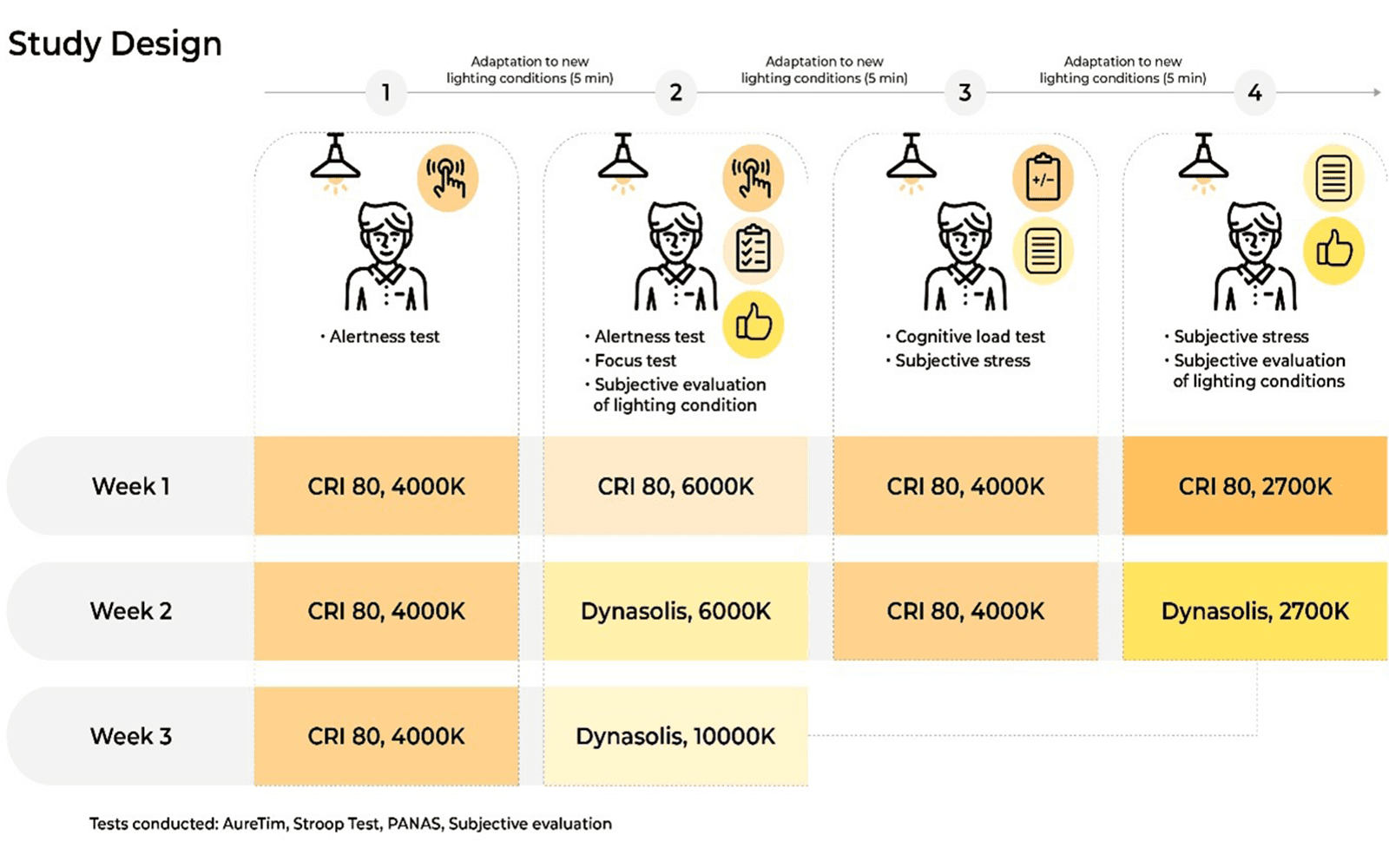
The Fraunhofer IBP carried out comparative tests between standard LEDs (2700K, 4000K, and 6000K, each with a CRI 83+) and the Dynasolis solution at color temperatures of 2700K, 6000K, and 10000K (Fig. 1). The tests were designed to analyze the cognitive and psychological effects of different light color temperatures and spectrum on approximately 35 test subjects per test series, which included evaluating how the light can impact alertness, attention, and relaxation.
Inclusion of cyan increases attention
The Stroop-Task, a commonly used attention task, was carried out to evaluate the different effects of the standard LEDs and the Dynasolis solution on attention. Here, the subjects were asked to read e. g. the word "green" but written in red. These tests revealed significantly shorter reaction times of the subjects when conducted under the Dynasolis 6000K solution when compared to the standard LED with no cyan at the same color temperature (Fig.2). There were also clear differences between the Dynasolis variations with an increase of cyan, with subjects responding faster under Dynasolis 10000K than Dynasolis 6000K.
Fig.2 Results for attention (Stroop Task)
Color temperatures impact human reception
In the alertness test based on the AuReTim method where subjects were requested to press a button when they heard a beep from the headphones they wore, the study established that alertness is directly impacted by the color temperature, regardless of whether it is the standard LED or Dynasolis solution. The test subjects were less alert when exposed to a color temperature of 4000K when compared with exposure to a color temperature of 6000K.
To test relaxation potentials, subjects were first placed in a room with standard LED 4000K, where they were allowed to acclimate to the light for five minutes. They were then placed under stress for 7 minutes with a cognitive task. This stress level was determined with a PANAS (Positive and Negative Affect Schedule) Test. This was followed by a five-minute relaxation phase under new lighting conditions (standard LED 2700K, versus the Dynasolis 2700K) with stress levels then being determined again. The results showed that the subjects were more relaxed under 2700K than under 4000K, regardless of the standard LED or Dynasolis.
Dynasolis – Human Centric Lighting Solution of new era
The results of the Fraunhofer Institute for Building Physics clearly show the advantages of the Dynasolis solution. The tunable Dynasolis can provide equal or better results in the different phases of human lighting needs than a variety of standard LEDs. This is due to the color temperature tunability and melanopic illuminance tunability which is unique to Dynasolis.
In particular, the attention tests revealed significant improvements in reaction times of the subjects under Dynasolis. The good performance with regards to relaxation enables Dynasolis for the full spectrum of applications. For example in hospitality applications guests can find anything from a good place to work to a place to recover after a long day.
"The results of the Fraunhofer Institute IBP's tests confirm the goals we had when we developed the Dynasolis solution," said Ulf Meiners, Managing Director of Nichia Europe. "We set out to develop a solution for working environments that follows the principle of Human Centric Lighting. Conventional Human Centric Lighting systems mainly work by changing color temperature, the visual element. However, Dynasolis solution has been developed based on a totally new concept of changing both color temperature and melanopic illuminance simultaneously to support human circadian rhythms. It is a Human Centric Lighting solution of a new era.”
To learn more about Dynasolis, please refer to Nichia’s website.




