
Human-centric Lighting
DeLIGHTed Talks: Good Light – How to Create it Indoors | November 3rd, 2025 (3PM CST)
Discover how to create good indoor light at DeLIGHTed Talks #9 on November 3. With insights from IALD, WELL, DLA, SLRCH, and leading researchers, this webinar explores daylight-like conditions indoors and their impact on health, design, and circadian well-being. Join the discussion and gain…
Published by LED professional ·
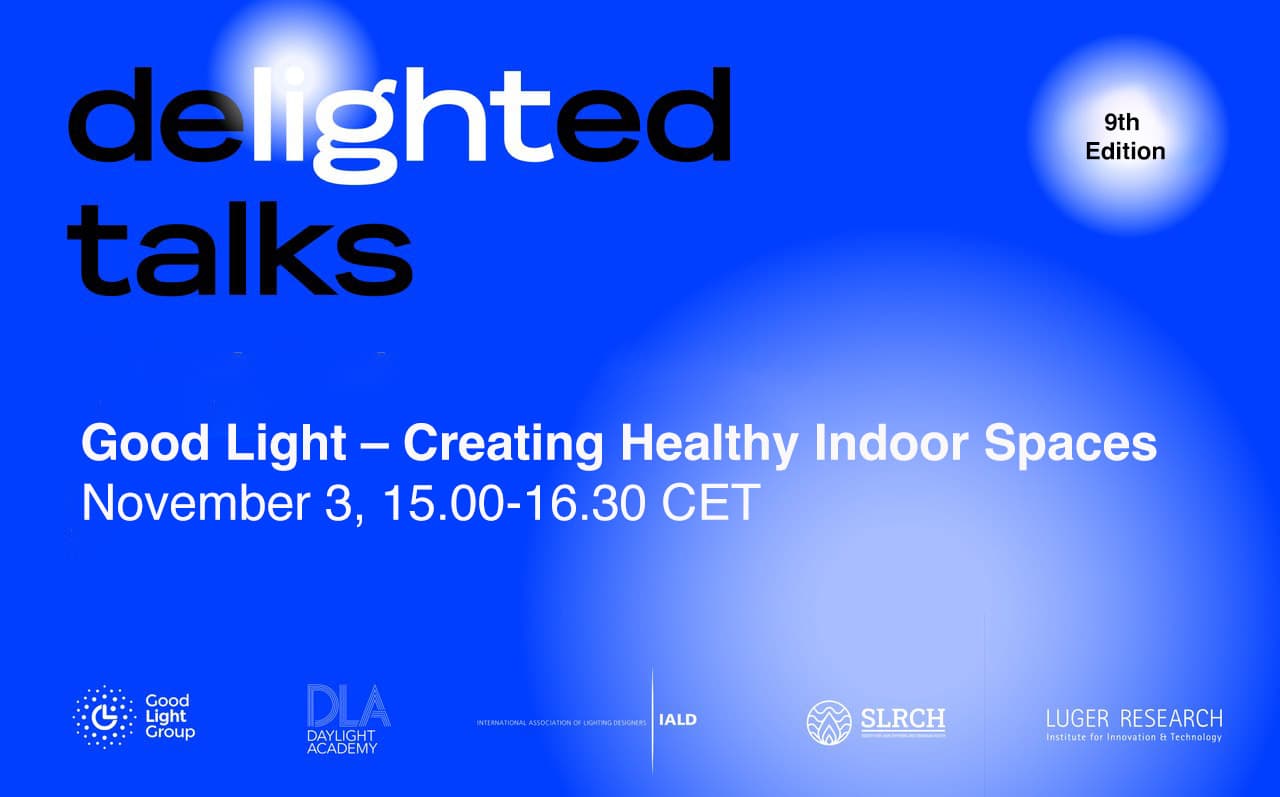
With an increasing evidence base that properties of daylight can positively affect people’s health and well-being, time has come to address the challenge of daylight-like conditions indoors. At present, many people spend time in spaces lit with electric lighting – at work places and in classrooms. How to design the built environment with appropriate light exposure in mind is the topic of a recent white paper by the the International Association of Lighting Designers (IALD).
During this webinar their findings will be presented and commented and contextualized by researchers and practitioners selected by the Daylight Academy, the International WELL Building Institute and the Society of Light, Rhythms and Circadian Health.
This webinar will take place during the Daylight Awareness Week 2025 (3-7 November) held under the title ‘Future Solar Societies’. Further events and information materials on how a world can be shaped by the power of the sun can be found on the Daylight Academy’s (DLA) event page.
>>> REGISTER FOR THIS EVENT HERE <<<
November 3rd, 2025 (3.00-4.30PM CST)
Introduction | Lisa Wu | 10 min | Reykjavik Univ., Iceland |
IALD White Paper | Kevan Shaw | 30 min | Loughborough Univ., UK |
Expert Statement | Nathan Stodola | 5 min | City Univ. New York, US |
Expert Statement | Luisa Brotas | 5 min | Royal Borough of Kingston, UK |
Expert Statement | Johannes Zauner | 5 min | Technical Univ. Munich, Germany |
Panel discussion | Lisa Wu (moderator) | 30 min |
Lisa Maria Wu is Associate Professor at both Reykjavik University in Iceland and Aarhus University in Denmark. She has a PhD in clinical psychology. Her clinical background was focused on general clinical psychology, clinical health psychology, neuropsychology, and neuropsychological rehabilitation of individuals with brain injury and other neurological impairment. As a researcher, her primary research areas include the study of circadian rhythms and sleep, as well as the investigation of side and late effects of cancer, including cognitive impairment, sleep disturbance, depressed mood, and fatigue, and the quality of life of oncology patients. A large part of her work relates to intervention development in these areas, including the development of neuropsychological rehabilitation approaches and circadian-driven interventions.
Lighting Design for Health, Wellbeing and Quality of Light, A Holistic Approach
by Kevan Shaw
This presentation covers the content of the similarly titled IALD white paper. It covers the current thinking on non visual effects of light and provides some practical guidance on how to incorporate this in the lighting design process. It also includes some more recent information and case studies showing how Integrative Lighting is being applied in real projects.
Kevan Shaw has spent his entire career in lighting. After working in stage lighting through his twenties and early thirties he established Kevan Shaw Lighting Design as an architectural lighting design practice in 1989 and remains a consultant to them. Strongly committed to the profession and sustainability he continues to serve the IALD a board member and as leader of the European Regulatory Affairs working group regularly contributing to consultations with the EU and UK policy makers and is a member of CEN standards work groups. His contribution to the profession has been recognised in the Lux Lighting Designer of the year award, a LIT lifetime achievement award and election to the IALD college of Fellows as well as many project awards over the years. He developed a strong interest in non-visual effects of light and has led the group writing the IALD white paper on Integrative lighting. He has lectured on University masters courses on lighting and frequently presents at lighting conference on various lighting topics.
Johannes Zauner works as a researcher and lecturer in the field of "Light and Health" at Munich University of Applied Sciences, having completed his PhD in Human Biology. After his apprenticeship in architectural drafting, he studied Interior Design and Architecture, and worked as a freelance planner as well as in research on energy-efficient buildings, daylighting and artificial lighting. Inspired by a pilot project in the field of "Light and Health" with the German Federal Environmental Foundation (DBU), he shifted his research focus to study the effects of light on humans. As a freelance partner of the Munich lighting design and engineering firm 3lpi he incorporates his studies into planning practice. Johannes Zauner is a member and spokesperson for the technical-scientific committee (TWA) of the German Lighting Technology Society (LiTG) for melanopic light effects, as well as a member of the Expert Forum for Interior Lighting (EFI).
Luisa Brotas is an architect and has a PhD in Daylighting and Planning. She has a profound knowledge of subjects associated with sustainability in the built environment gained in 20 years of experience in research and academia, including a role as Course Leader of an MSc Architecture, Energy and Sustainability at London Metropolitan University. Luisa is currently working at the Royal Borough of Kingston Upon Thames as Sustainability and Infrastructure Lead. Luisa is also member of the Daylight Academy (DLA).
Nathan Stodola is Chief Engineer at the International WELL Building Institute (IWBI). Over the last 14 years, he has helped evolve the WELL Building Standard to improve health and well-being in over six billion square feet of real estate. His particular focus has been on Light, Sound, Air, and Thermal Comfort. In his spare time, he enjoys playing accordion and finding new bike routes in the greater New York City area.




