Human-centric Lighting

Certificate of Advanced Studies (CAS) in Light and Chronobiology

The CAS Light and Chronobiology integrates topics covering the biological effects of daylight from various fields such as architecture, chronobiology, lighting design, medicine and psychology. This opens up theoretical and, above all, practical applications for improving public health.

Published by LED professional ·
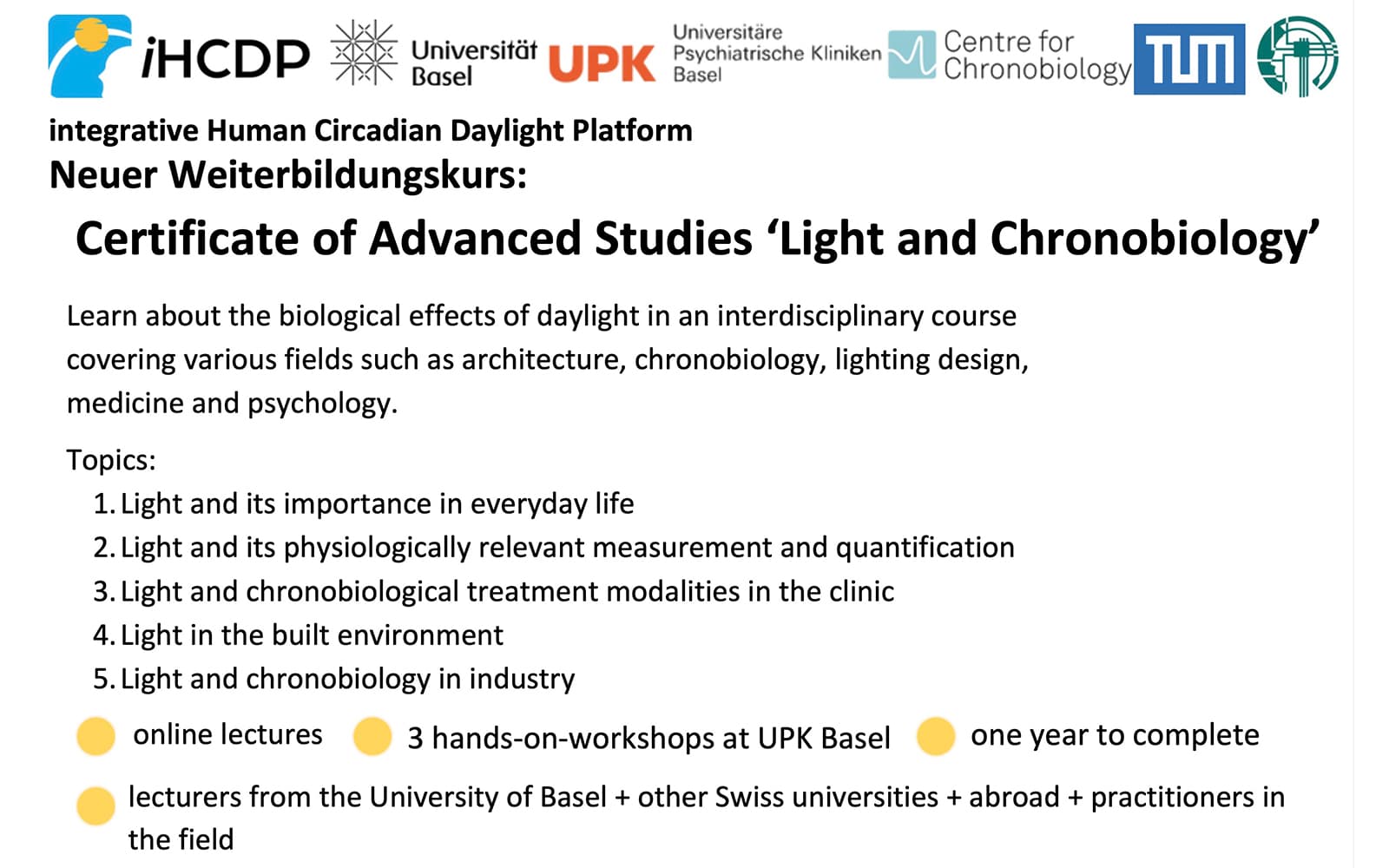
Certificate of Advanced Studies (CAS) in Light and Chronobiology

The Integrative Human Circadian Daylight Platform (iHCDP) is a project led by four researchers at the Centre for Chronobiology at University of Basel/University Psychiatric Clinics Basel, Max Planck Institute Tübingen and Technical University Munich. The platform aims to catalyse any means necessary for the use of (day-)light to improve general health, quality of life and living conditions across the life span, based on biological, psychological and societal needs.

To bring together researchers, clinicians, light designers, architects, and educators in the fields of daylight research, ophthalmology and vision science, and sleep- and circadian medicine the team established a Certificate of Advanced Studies (CAS) in Light and Chronobiology associated with University of Basel.

The CAS Light and Chronobiology integrates topics covering the biological effects of daylight from various fields such as architecture, chronobiology, lighting design, medicine and psychology. This opens up theoretical and, above all, practical applications for improving public health. Attached you find a flyer. We'd be glad if you could share it with everyone who might be interested in this course. Registration is open until 31 July.

Nadja Schaubhut, MSc

iHCDP Coordinator

Integrative Human Circadian Daylight Platform (iHCDP)
Centre for Chronobiology
Psychiatric Hospital of the University of Basel

Research Platform Molecular and Cognitive Neurosciences, University of Basel

+41 (0) 61 325 53 28 (Mondays)

nadja.schaubhut@unibas.ch

ihcdp.org

Did you like this article?

Share this article

You could also like this

Human-centric Lighting

Sunlight, UVB and Vitamin D – Human Centric Lighting Beyond Melanopic Stimulation

by Ir. Rémy C. Broersma and Dr. Ir. Marcel P. Lucassen, Scientists at Signify Research Eindhoven UVB radiation initiates vital processes in our body, one of which is the production of vitamin D in the skin. It is well known that over-exposure to the sun may bring a risk. Less well known is that the same is true for insufficient sun exposure due to our indoor lifestyle. In Part 1 of this article, we first describe the scientific understanding behind vitamin D. In Part 2 we describe how artificial light can be enriched with a safe, low dose of UVB, to supplement natural vitamin D production in the skin. Not too much, not too little.

Human-centric Lighting

Light in the Service of Health – Bringing the Science of Light and Health into Everyday Life through Evidence-based Communication

Light does far more than let us see. In this episode of the LED professional podcast, Manuel Spitschan and Laura Kervezee, co-chairs of the Light for Public Health Initiative, explain how light acts as the master regulator of the body’s internal clock: it synchronises our physiology with the day outside, shapes mood and alertness, and times the release of melatonin, the hormone that governs sleep. The science is settled enough to act on, so the initiative has distilled it into 26 consensus statements on how light affects the body and well-being, written as practical, evidence-based guidance for individuals, employers, schools and cities. A compact 14-minute briefing on why good light is a public-health question, and what to do about it. Based on the authors’ article in LED professional Review #112.

Human-centric Lighting

deLIGHTed Talks #8: Good Light – Good Sleep

Full recording of deLIGHTed Talks #8, held online by LpS DIGITAL on 24 April 2025 (91 minutes). Dr. Renske Lok (Stanford University) shows that bright light during the day deepens nighttime sleep, reduces nighttime awakenings, improves sleep efficiency and lowers next-day sleep inertia. Dr. Jeffrey Hubbard (University of Lausanne / EPFL) compares how light and darkness drive sleep and wakefulness in nocturnal mice and day-active Sudanian grass rats. Chronobiologist Dr. Virginie Gabel, founder of Clock&Me, moderates the session and the discussion on what the findings mean for lighting design.

Human-centric Lighting

COMMENTARY: Good Light – The Next Growth Story for Our Lighting Industry

Good Light — also called Human Centric or Integrative Lighting — can become the lighting industry’s next growth story by focusing on health, wellbeing and performance rather than energy alone.

LuminusEdison optoLTF TechnologyLoreos

The latest Press Releases

Explore All

Stay current with our monthly Update from the lighting industry

LEDprofessional Newsletter

You will receive a confirmation e-mail. Unsubscribe anytime.
