McLED

UV / IR

Toyoda Gosei Develops UV-C LED with World-Class Light Output

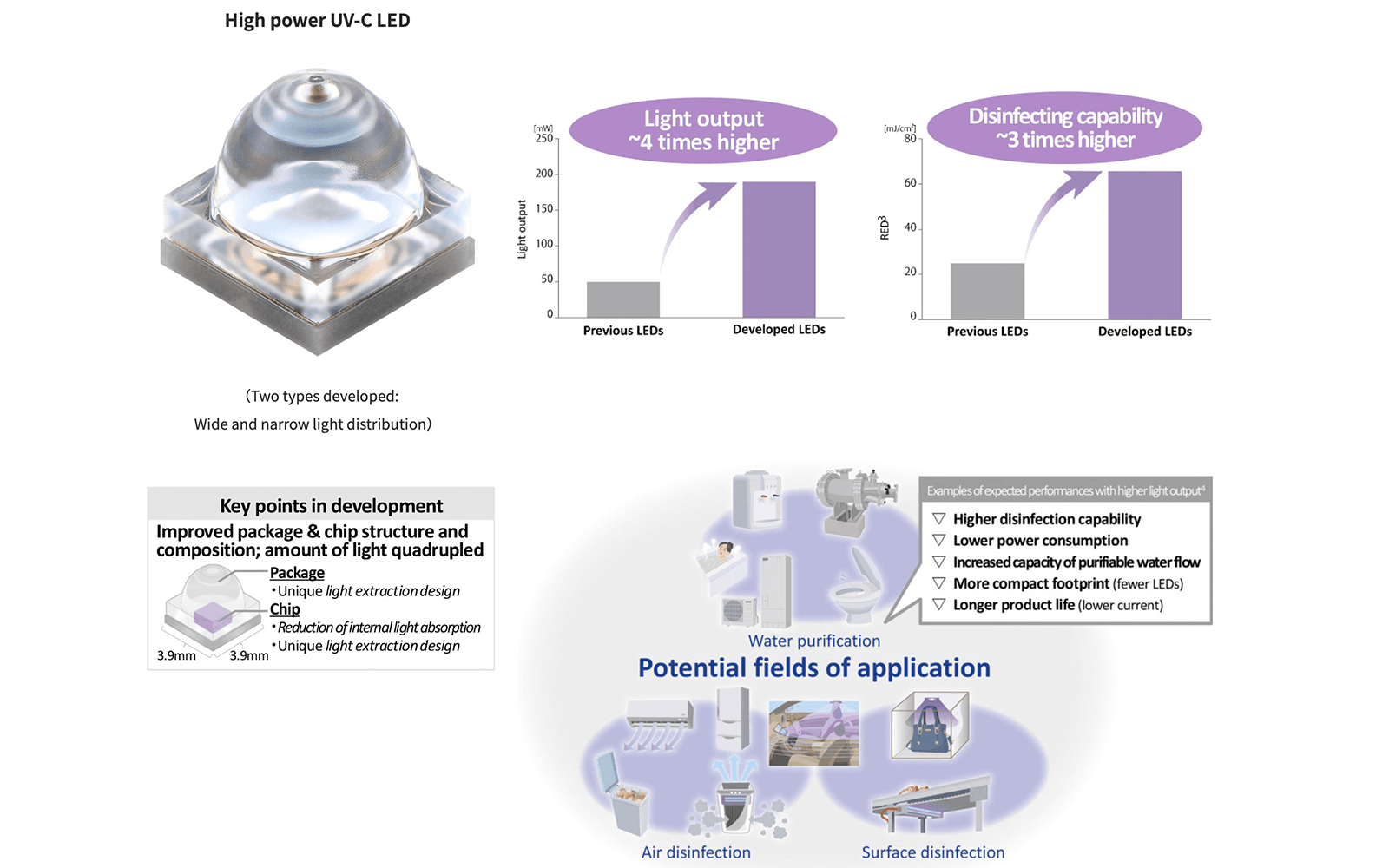
Toyoda Gosei Co., Ltd. has developed deep ultraviolet (UV-C) LEDs with light output that is among the highest in the world. UV-C is used in disinfection as it destroys viral and bacterial DNA structures and inhibits their replication. As an alternative light source for mercury lamps used for…

Published by LED professional ·
Toyoda Gosei Develops UV-C LED with World-Class Light Output

Compared with mercury lamps, UV-C LEDs are environmentally-friendly as it is mercury-free, more compact, and have a longer life. These advantages promoted their wide use in devices for disinfecting air and surfaces during the Covid-19 pandemic. Since they differ from lighting LEDs in composition, however, light output has been still limited. For water purification plants and other situations where high disinfection performance is needed, mercury lamps are still used.

Toyoda Gosei has leveraged its expertise in crystallization and design of blue LEDs for lighting, and successfully developed UV-C LEDs that achieve light output at the level of 200 milliwatts with a single chip when driven by a current of 350 milliamperes. Improvement of the LED structure and composition quadrupled the amount of light that can be extracted. Enhanced LED performance including disinfecting capability of about three times higher will expand their applicable areas including a future alternative to mercury lamps, contributing to more hygienic and safer living.

1 As of March 31, 2024. Toyoda Gosei survey

2 Sample sales start in Japan, China, and South Korea in April 2024. Successive starts are planned for other regions.

3 Reduction Equivalent UV Dose is an indicator of disinfection performance

4 Expected performances also depend on disinfection device specifications and conditions

Did you like this article?

Share this article

You could also like this

UV / IR

Far-UVC LEDs transmit data at record speed | Ferdinand-Braun-Institut

Researchers at Ferdinand-Braun-Institut (FBH), the University of Strathclyde, and the University of Cambridge demonstrated wireless optical communication using far-UVC LEDs at wavelengths below 235 nm, achieving data rates up to 1.5 gigabits per second over a 30 cm line-of-sight link. The FBH-developed LEDs are optimized for high optical power and fast modulation by segmenting the emitting surface to reduce capacitance and increase current density. Far-UVC offers low solar background outdoors and stronger Rayleigh scattering for potential non-line-of-sight links. Next steps include testing longer distances, non-line-of-sight performance, and environmental effects on transmission.

UV / IR

PureFize Presents Field-emission Cathodoluminescent Approach for Next-generation Far-UVC Devices

Swedish UV technology company presents breakthrough results showing deep-UV emission below 240 nm from a scalable, phosphor-tunable device platform.

UV / IR

Violumas Has Launched New 255nm, 265nm, and 275nm LEDs

Violumas, provider of high-power UV LED solutions and inventor of 3-PAD LED technology, has released its next-generation 255nm, 265nm, and 275nm LEDs in both SMD and COB configurations.

UV / IR

LEDINTRO Introduces Breakthrough Harmless 230nm UV LED Air Sterilization Ball

Ultraviolet radiation has long been recognized as an effective method for inactivating airborne and surface-borne microorganisms. However, the widespread use of conventional UV-C sources has been constrained by safety concerns, as prolonged human exposure to traditional germicidal wavelengths is…

Luminuscree ledEdison optoTE connectivityLTF TechnologyLoreos

The latest Press Releases

Explore All

Stay current with our monthly Update from the lighting industry

LEDprofessional Newsletter

You will receive a confirmation e-mail. Unsubscribe anytime.