
Smart Lighting
New Study Unveils How Artificial Light Entraps Nocturnal Insects: A Call for Eco-friendly Lighting Solutions
The study explores why nocturnal insects are attracted to artificial lights, challenging the traditional theories of "lunar navigation" and "escape to light."
Published by LED professional ·
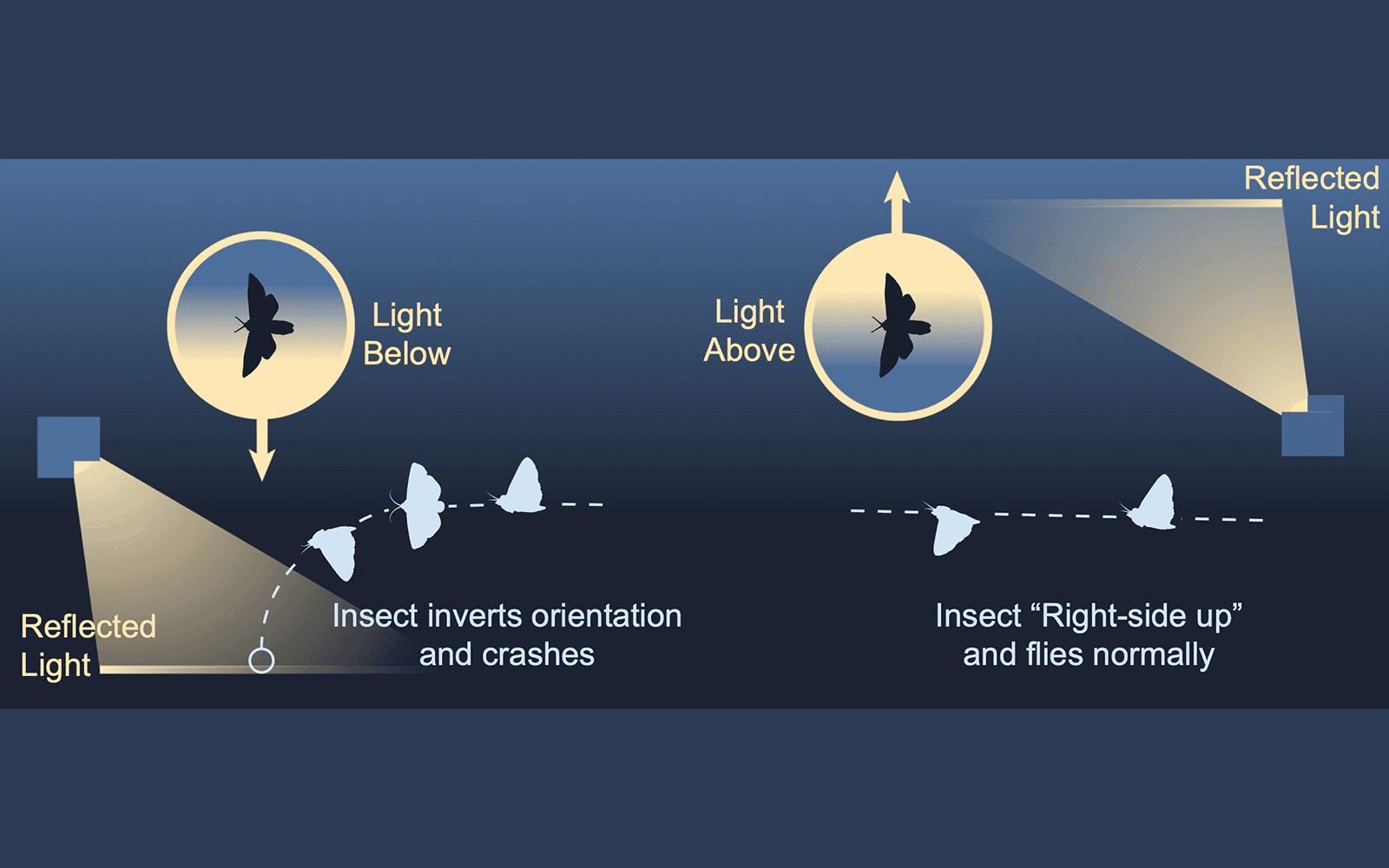
Utilizing high-resolution motion capture and stereo-videography, the researchers identified that insects do not fly directly towards light. Instead, they exhibit abnormal flight behaviors such as orbiting, stalling, and inversion due to a dorsal light response (DLR), where they tilt their dorsal side towards the light. This response, beneficial under natural light conditions for maintaining flight attitude, leads to disorientation and entrapment around artificial light sources. The study's findings suggest that artificial lights disrupt insects' ability to navigate by altering their perception of vertical orientation. Simulations confirmed that dorsal tilting alone is sufficient to induce light entrapment, offering a new perspective on the interaction between insects and artificial lights. This research has implications for understanding the ecological impacts of light pollution and offers insights into insect flight control mechanisms.
How Artificial Light Should be Modified
The study suggests that to mitigate the attraction and entrapment of nocturnal insects by artificial lights, adjustments could be made to the spectral composition, intensity, and directionality of these lights. Specifically, minimizing the use of lights with wavelengths that insects are highly sensitive to, reducing the overall brightness, and directing lights downwards or using shields to prevent light from dispersing upwards can help. By implementing these changes, it may be possible to reduce the negative impact of artificial lighting on insect populations and the ecosystems they support.
Adjusting the spectral composition involves using light wavelengths that are less attractive to insects. This typically means avoiding ultraviolet and blue light, which are highly attractive to many nocturnal insects, and instead using lights with warmer colors, such as yellow, amber, or red, which are less visible or attractive to them. These adjustments can help reduce the disruptive effects of artificial light on nocturnal insects, potentially minimizing their attraction and the ecological impact of light pollution.
https://www.nature.com/articles/s41467-024-44785-3
Samuel T. Fabian 1,5 , Yash Sondhi 2,3,5 , Pablo E. Allen 4, Jamie C. Theobald 2,6 & Huai-Ti Lin 1,6
1 Department of Bioengineering, Imperial College London, London SW7 2AZ, UK. 2 Institute for Environment, Department of Biology, Florida International University, Miami, FL 33174, USA. 3 McGuire Center for Lepidoptera and Biodiversity, Florida Museum of Natural History, University of Florida, Gainesville, FL 32611, USA. 4 Council on International Educational Exchange, Monteverde Apto 43-5655, Costa Rica. 5 These authors contributed equally: Samuel T. Fabian, Yash Sondhi. 6 These authors jointly supervised this work: Jamie Theobald, Huai-Ti Lin. e-mail: s.fabian@imperial.ac.uk; yashsondhi@gmail.com.
Published by https://www.nature.com/ncomms/




