
Optics
In the Future, Substances can be Identified by Miniature Devices Based on Metalenses
A VTT led research project is developing compact spectral imaging and gas measurement technologies for industries and medical diagnostics. Innovations based on the science of light, i.e. photonics, use, for instance, infrared light to identify gases. With the new optical MEMS solutions,…
Published by LED professional ·
The EPheS (Efficient Photonics for Sustainable Imaging and Sensing) project, involving four pioneering companies and two research institutes, is developing tunable optical spectral filters and systems based on them. These solutions serve a wide range of applications, ranging from environmental monitoring such as hazardous gas detection, green energy initiatives to food and pharmaceutical safety as well as medical diagnostics, such as tissue analysis.
“Novel spectral imaging and gas measurement technologies are essential for creating a sustainable circular economy. They can be used to reduce the carbon footprint of different industries and increase the carbon handprint, i.e. the positive environmental impact of these technologies,” says Aapo Varpula, project coordinator and Research Team Leader for Medical microsystems at VTT.
Launched at the beginning of 2025, the three-year project is a part Chip Zero ecosystem that is run by Applied Materials. The other project partners are Tampere University, Vaisala, Gasera and Schott Primoceler.
“Our collaboration has got off to a flying start. We’re currently in the design phase, and we’ll start component fabrication in VTT’s cleanroom for 200 mm wafers around the turn of the year. This is an excellent opportunity for VTT to develop novel infrared spectral technologies and demonstrate them in new applications,” explains Varpula.
Metalenses and MEMS technology enable a breakthrough
The project stands out globally due to the unique combination of expertise in materials, metaoptics, MEMS (micro-electromechanical system) and integrated optical systems brought together by its partners.
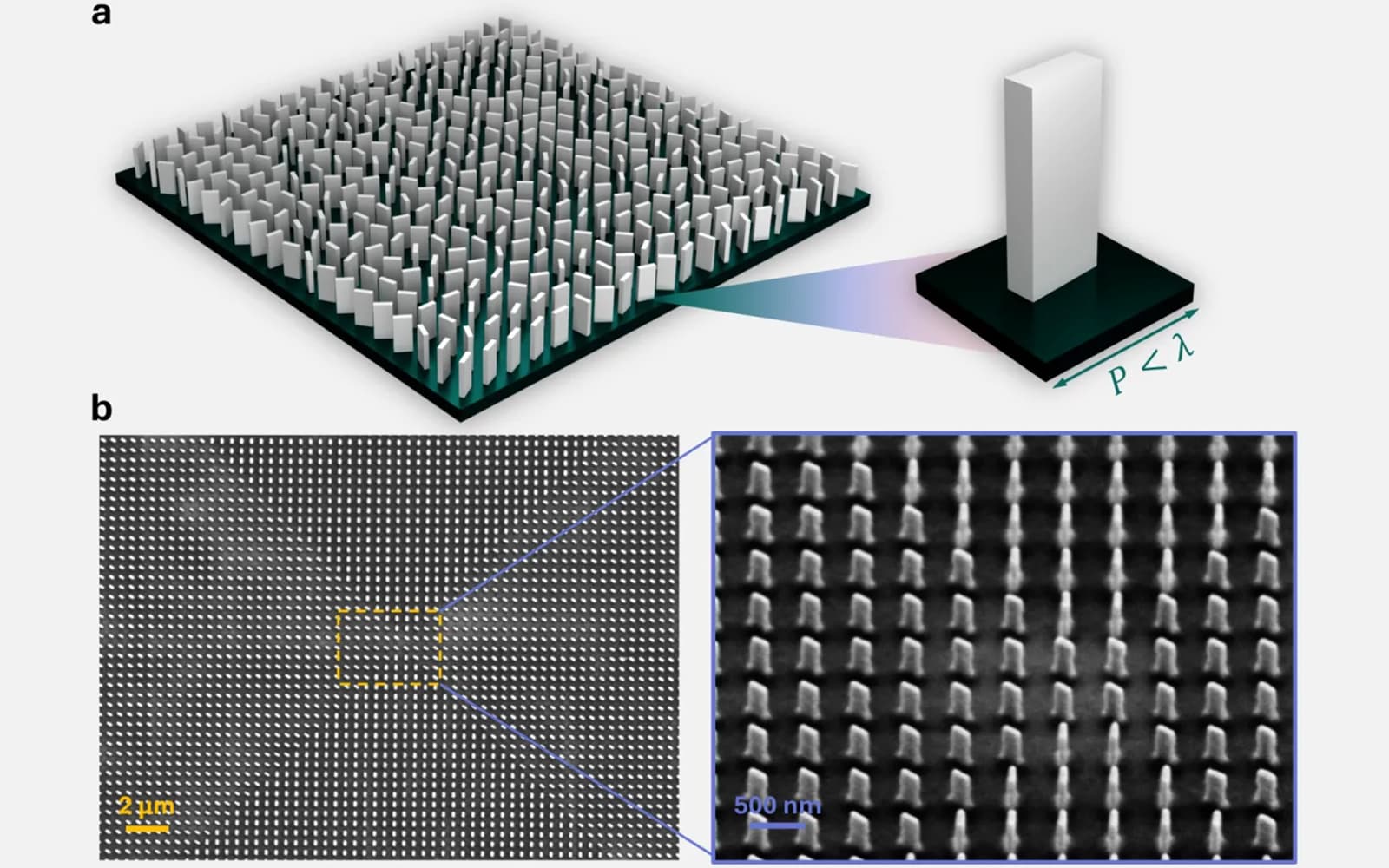
EPheS combines metalenses and MEMS-based adjustable infrared filters into compact systems for the spectral-based detection of gases and hyperspectral imaging.
“Metalenses are flat, nanostructured lenses that can replace traditional optics. This enables the manufacturing of simpler, lighter and more resource and cost-effective systems,” says Varpula.
In Finland, metaoptics is still rarely used in industrial applications. In the project, new technology in the long-wave infrared (LWIR) range enables both more efficient gas sensor performance and the miniaturisation of systems. Sustainability is highlighted in the project by the ecological choice of materials. For example, silicon is non-toxic and widely available, unlike many conventional infrared materials, which are expensive, rare and toxic.
Gases can be detected with infrared light and audio signals
The photonics technologies being developed allow the analysis of, for example, gases and materials in real time and with high sensitivity. This can be achieved without interference from other gases, using methods such as photoacoustics or infrared spectroscopy.
The gas sensors and instruments use microfabricated tunable LWIR filters.
“In the photoacoustic method, gas is collected into a measurement chamber and irradiated with infrared light. When the light is absorbed by the gas, it generates an audio signal. This will only happen when the chamber contains a specific gas for which the wavelength of the infrared radiation is tuned,” Varpula explains.
Tunable Fabry-Pérot interferometer-based MEMS filters employ optical membranes separated by an air gap. The layered structure composed of a thin silicon membrane enables efficient operation in the LWIR range.
Conventional solutions are expensive, large and only work for one gas at a time. New adjustable components facilitate the detection of a wide range of gases. They are also smaller and cheaper and enable more versatile gas measurement systems.
A national competence cluster under construction
As part of the Chip Zero ecosystem, the EPheS project brings photonics expertise and builds a national competence cluster.
“As part of the EPheS project, the atomic layer deposition (ALD) delivers exceptional material quality and reliability for advanced optical components - driving breakthroughs in spectral imaging and gas sensing. From ultra-thin coatings for multispectral filters to durable layers for MEMS FPIs, we need to ensure precision at the nanometre scale. We are proud to be part of this collaboration developing sustainable, high-performance solutions that are set to redefine environmental monitoring, industrial automation, and beyond”, says Jesse Kalliomäki, Senior Scientist at Applied Materials in Finland.
“At Tampere University, we develop metaoptic components that manipulate light with nanoscale precision. Within EPheS, our focus is on designing metalenses and metasurfaces that bring advanced imaging and sensing functionalities into compact, integrated formats. By combining metaoptics with MEMS technology, we aim to make high-performance photonic systems more sustainable, scalable, and accessible for real-world applications,” says Humeyra Caglayan, Professor of Physics at Tampere University.




