
Design & Architecture
World Premiere: Lighting Designer Ingo Maurer's Exclusive Table Light with Organic LED from Osram
The renowned lighting designer Ingo Maurer is the first to use organic LEDs (OLEDs) from OSRAM in a function table light. The light, known as “Early Future”, is being produced as a limited edition. It works with tiles straight from the laboratory and demonstrates the enormous potential of OLEDs…
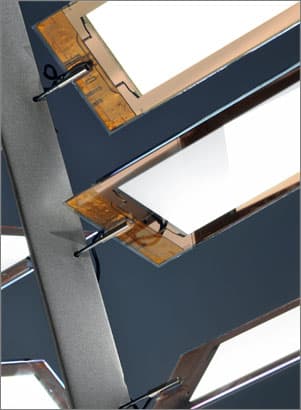
At the Light&Building fair, OSRAM Opto Semiconductors and Ingo Maurer will today unveil a revolutionary lighting application based on OLEDs. The company has made prototypes of organic light emitting diodes available to the designer for his exclusive creation. “We are proud that our OLEDs have inspired such a renowned artist as Ingo Maurer to create such an exciting work of art. “Early Future” is a vision that has become reality. It gives us a glimpse of just how versatile organic OLEDs can be in terms of their design options and applications”, said Martin Goetzeler, CEO of OSRAM.
From prototypes to works of art:
Ingo Maurer used tiles with an area of 132 x 33 millimeters for his creation. For Maurer, unusual design is not an end in itself. “Early Future represents an important stage in the transition from abstract object to functional designer lighting”, he said. Maurer has been shaping developments in light as art and lighting design for many years. In 1966 he exhibited the designer luminaire Bulb which has been on show in the New York Museum of Modern Art since 1969 along with other works of his. Ingo Maurer has received numerous awards for his avant-garde work with light.
OLEDs – a journey from the laboratory to the home:
Organic LEDs offer all the familiar benefits of LEDs such as high energy efficiency, low operating voltage and mercury-free design, and have some impressive properties of their own. The light source is not a collection of individual light points but a uniform light-generating surface. Initial laboratory prototypes from OSRAM showed last year the property of transparent light in a usable tile size. Thanks to the layer structure, it is possible to produce not only very thin OLEDs but also scalable ones.
OSRAM Opto Semiconductors has a team of around 50 research engineers working on the development of OLEDs. Some applications may seem like science fiction but they are realistic possibilities. “In the future it will be possible to use OLEDs as flexible or transparent light sources. A transparent OLED over a window in a roof would be able to allow natural light in during the day and provide fascinating illumination for the room at night”, said Dr. Bernhard Stapp, Head of Solid State Lighting at OSRAM Opto Semiconductors. There are possible applications for these new light sources in the automotive industry as well. Rear lighting elements could be integrated entirely within the rear windshield.
For further information, please visit:
http://www.ingo-maurer.com
http://www.osram-os.com/OLED-vision-becomes-reality




