McLED

LEDs & Light Sources

WHITE PAPER: Achieving Optimal Color Rendition with LEDs

A Review of Various Models for Classifying Light Source Color Rendition and Guide to Using LEDs to Achieve Fidelity Color Rendering for Retail and Other Indoor Environments.

Published by LED professional ·
WHITE PAPER: Achieving Optimal Color Rendition with LEDs

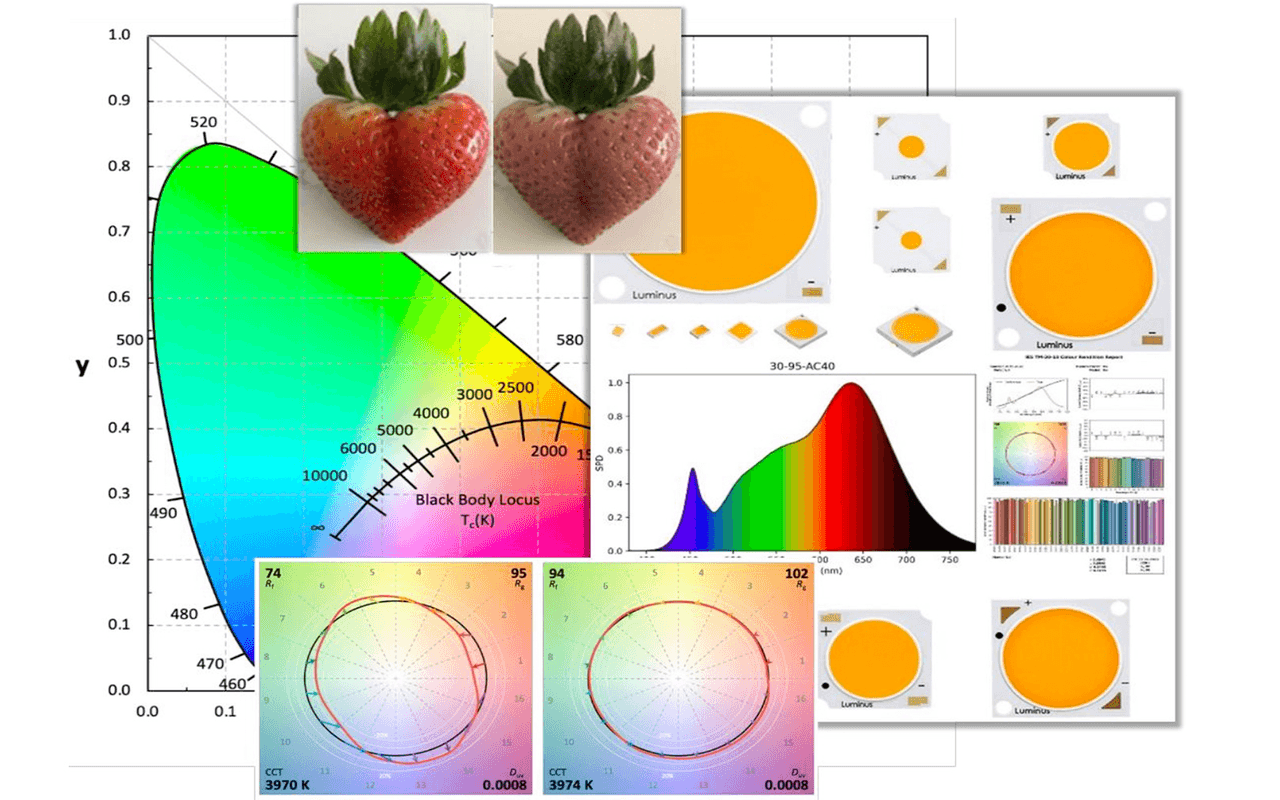
One of the essential functions of human vision is perceiving color, which is an important source of information about our world. For example, the bright red color of a ripe strawberry tells us it is ready to eat. Humans see color as a function of reflectance—specific wavelengths of light reflected into our eyes. Lighting profoundly affects how we see color by either accentuating or altering how various wavelengths appear.

This White Paper explains color rendering—how light affects the appearance of the colors we see. It describes the various systems used for measuring the color rendition capability of light sources, such as the Color Rendering Index (CRI), Gamut Area Index (GAI), TM-30, and more. We compare these methods and discuss how they have evolved to provide more accurate assessment of LEDs for different lighting needs.

By properly applying these indices, you can create the right lighting scheme for virtually every type of environment—from retail stores to surgical operating rooms. We describe the superior color rendition capabilities of Luminus LED products, including Standard LEDs, SensusTM, PerfectWhiteTM, Hospitality COB SeriesTM, and SaludTM, and how they help architects and lighting designers to meet specific functional lighting objectives.

– Download White Paper –
Achieving Optimal Color Rendition with LEDs

Authors: Paul Sims, Yi-Ying Lai, Tom Jory

Did you like this article?

Share this article

You could also like this

Digital Photonics

Polar Light and Foxconn explore MicroLEDs for data center links

Swedish MicroLED developer Polar Light Technologies has signed its first optical interconnect agreement – for links that carry data as light between chips and systems – with Foxconn Technology. Announced on November 12, 2026, the work focuses on 5 µm green MicroLEDs, the size Polar Light already makes on its pilot line, as light sources for AI data centers.

LEDs & Light Sources

ams OSRAM partners with Samsung Display, gains € 210 million investment

ams OSRAM and Samsung Display (SDC) will jointly develop next-generation ultra-small microLEDs for displays. SDC is also investing EUR 210 million in ams OSRAM for a stake of about 9.1%.

Smart Cities

Pulsiv opens early access to 80 W LED streetlight driver design

UK power electronics firm Pulsiv has opened an early access programme for an 80 W LED driver reference design for streetlights, announced on 24 November 2026. Built on its OSMIUM technology, the driver runs at 106–139 V so long-life dry polymer capacitors can replace failure-prone electrolytic ones, avoids the switch-on current surge that trips breakers, and targets 93 % efficiency at 230 VAC.

LEDs & Light Sources

Broadcom narrows the beam: RGB LED with 75° lens for signs

At electronica 2026 in Munich, Broadcom showed the LED professional team its ASCB-WTF0-0A30A: a tiny RGB LED (2.8 × 2.7 mm) whose built-in lens focuses red, green and blue light into a 75° cone instead of the usual 110–120°. More light reaches people standing in front of a sign – ideal for speed limit, highway message and taxi signs. Each color is driven separately.

Luminuscree ledEdison optoTE connectivityLTF TechnologyLoreos

The latest Press Releases

Explore All

Stay current with our monthly Update from the lighting industry

LEDprofessional Newsletter

You will receive a confirmation e-mail. Unsubscribe anytime.
