
LEDs & Light Sources
Toshiba Develops Transparent Photoluminescent Phosphor for LED, Sensing and Security Printing Applications
TOKYO—Toshiba Corporation (TOKYO: 6502) has unveiled a technology breakthrough in photoluminescence, a novel phosphor that delivers excellent solubility in polymers or organic solvents, where it is transparent and colorless under visible light, and that emits persistent red-light emissions under…
Published by LED professional ·
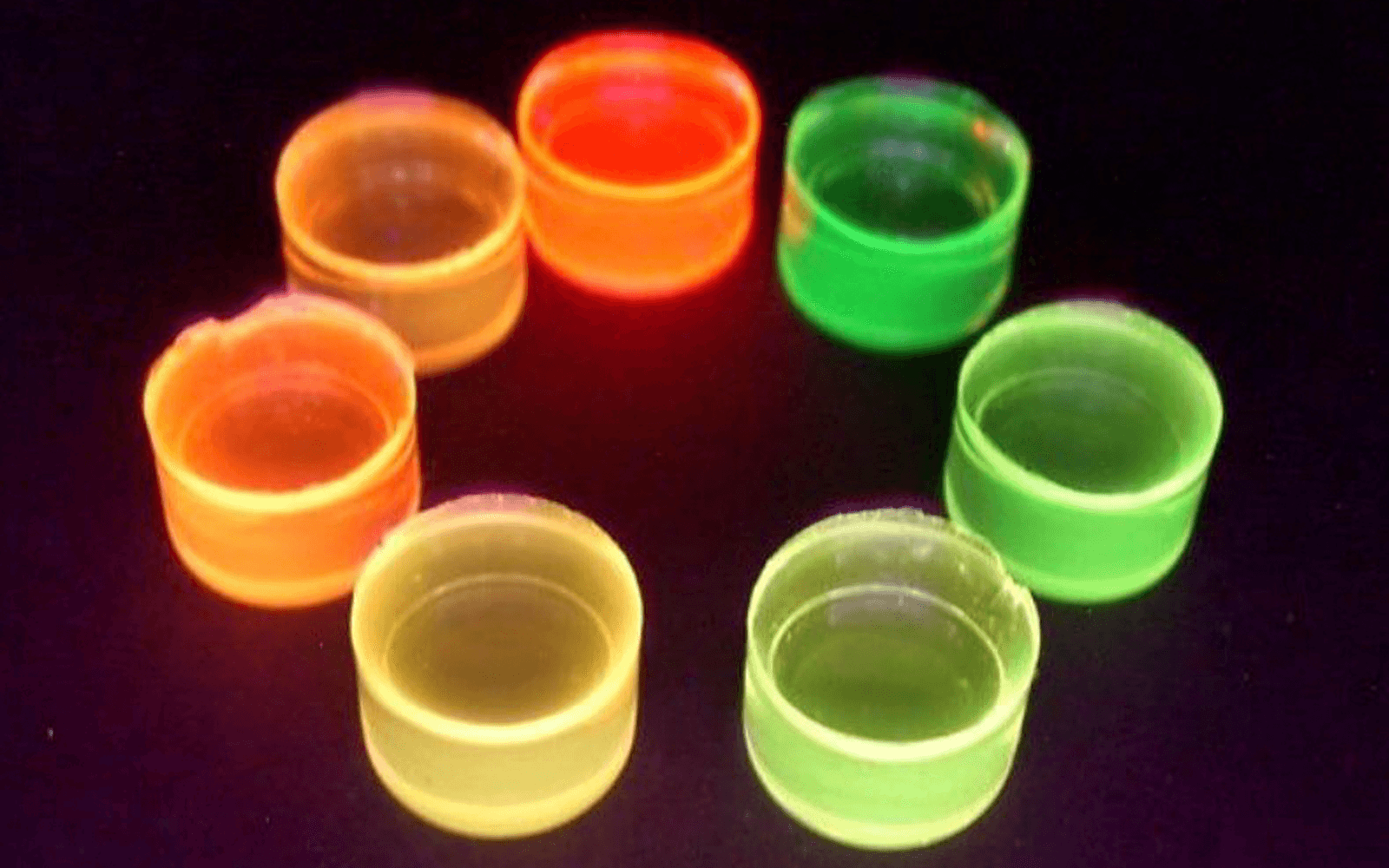
A phosphor is a substance that absorbs energy from a light source, such as UV or visible light, and releases that energy by emitting colored light. Phosphors are commonly used in LED lighting and displays, and in security printing. However, in the field of mini- and micro-LED lighting and displays, where the chips used are very small, the inorganic phosphors typically used have a limited color reproduction capability and luminescence intensity. These phosphors are also insoluble and exist as fine particles, and when used in security printing, printed patterns become faintly visible, depending on the angle of view and light exposure. Toshiba’s new phosphor overcomes these problems.
Figure 1: Applications of Toshiba's New Phosphor.
Toshiba has focused its photoluminescence research on novel lanthanide luminescent complexes. The company has developed a proprietary molecular design method, and used this to bind the ions of a standard Eu(III) luminescent complex with two or more phosphine oxide structures, including a branched tetraphosphine tetraoxide ligand recently discovered by Toshiba (Figure 2). This created a new structure that is highly soluble, with excellent transparency, and that successfully increases luminescence intensity to achieve high color purity and durable emission. The molecular design method also has the potential to create phosphors that emit different colored light when applied to different luminescent complexes (Figure 3).
Figure 2: Eu(III) complexes with two or more different phosphine oxide structures realized by Toshiba’s molecular design method.
Figure 3: The molecular design method has the potential to create phosphors that emit different colored light when applied to different luminescent complexes.
Researchers from Toshiba presented the technology and showcased red LEDs and fluorescent films as applications at the 29th International Display Workshops (IDW '22) 4 from December 14 to 16. A paper covering the technology was published on the IDW’ 22 website. Toshiba will soon begin to provide samples of the phosphor and fluorescent films and explore partnerships for applications in many areas, including the lighting, display, printing and chemical industries. The company aims to start mass production in 2025.
Table 1: Specifications of the new phosphor.
About Toshiba Corporation
Toshiba Corporation leads a global group of companies that combines knowledge and capabilities from over 140 years of experience in a wide range of businesses—from energy and social infrastructure to electronic devices—with world-class capabilities in information processing, digital and AI technologies. These distinctive strengths support Toshiba’s continued evolution toward becoming an Infrastructure Services Company that promotes data utilization and digitization, and one of the world’s leading cyber-physical-systems technology companies. Guided by the Basic Commitment of the Toshiba Group, “Committed to People, Committed to the Future,” Toshiba contributes to society’s positive development with services and solutions that lead to a better world. The Group and its 120,000 employees worldwide secured annual sales of 3.3 trillion yen (US$27.4 billion) in fiscal year 2021. Find out more about Toshiba at www.global.toshiba/ww/outline/corporate.html




