
UV / IR
Research Confirms Ushio’s Technology Is Effective Against a Variant of SARS-CoV-2
Hiroshima University and Ushio Inc. have been conducting a joint research project (Study on the disinfection (*1) and viral inactivation effects of 222 nm UV-C light using Care222). As part of this study, a group of researchers, including Professor Hiroki Ohge of the Department of Infectious…
Published by LED professional ·
Outline
A group consisting of Assistant Professor Hiroki Kitagawa, Assistant Professor Toshihito Nomura, and Professor Hiroki Ohge of the Department of Infectious Diseases at Hiroshima University Hospital, as well as, Professor Takemasa Sakaguchi of the Virology Section of the Graduate School of Biomedical and Health Sciences at Hiroshima University irradiated a SARS-CoV-2 variant using a device equipped with Ushio's Care222 filtered Far UV-C technology and confirmed that it has the same viral inactivation effect on the variant as on the original strain. The Care222 technology combines an excimer lamp with a center wavelength of 222 nm and a special optical filter that removes wavelengths above 230 nm that can be harmful to humans.
Background
In a previous study, this research group was the first in the world to demonstrate that Care222 technology is effective in inactivating the original strain of SARS-CoV-21) and that the inactivation effect depends on cumulative illuminance (total UV dose) regardless of the lighting method employed (continuous, intermittent, etc.) . 2)
COVID infections are rising in Japan and internationally due to multiple variants of SARS-CoV-2 now becoming the dominant strains. These variants have been shown to be more infectious and react differently to COVID vaccines.3) However, it has been found that the amount of ultraviolet light (UV-C) needed to inactivate the virus can be estimated.4) SARS-CoV-2 variants have mutations that occur during copying and proliferation in only certain parts of the genome, but these mutations have no major effect on genome size and pyrimidine nucleotide frequency,5) (*3) which ultimately determine the pathogen’s sensitivity to UV-C. It was thought that the viral inactivation effect of 222 nm UV-C should not differ between the original strains and variants, but no experiments on variants had been conducted yet.
Thus, Ushio, together with researchers from the Department of Infectious Diseases at Hiroshima University Hospital, and the Virology Section of the Graduate School of Biomedical and Health Sciences at Hiroshima University, conducted a joint research project to verify the viral inactivation effect of 222 nm UV-C light on a SARS-CoV-2 variant.
Research Details and Results
The researchers studied the inactivation effect of 222 nm UV-C on a clinically isolated strain of SARS-CoV-2 [N501Y mutation(+), E484K mutation(-)] (hereinafter, "the N501Y variant") and the original strain [N501Y mutation(-), E484K mutation(-)] (hereinafter, "the original strain").
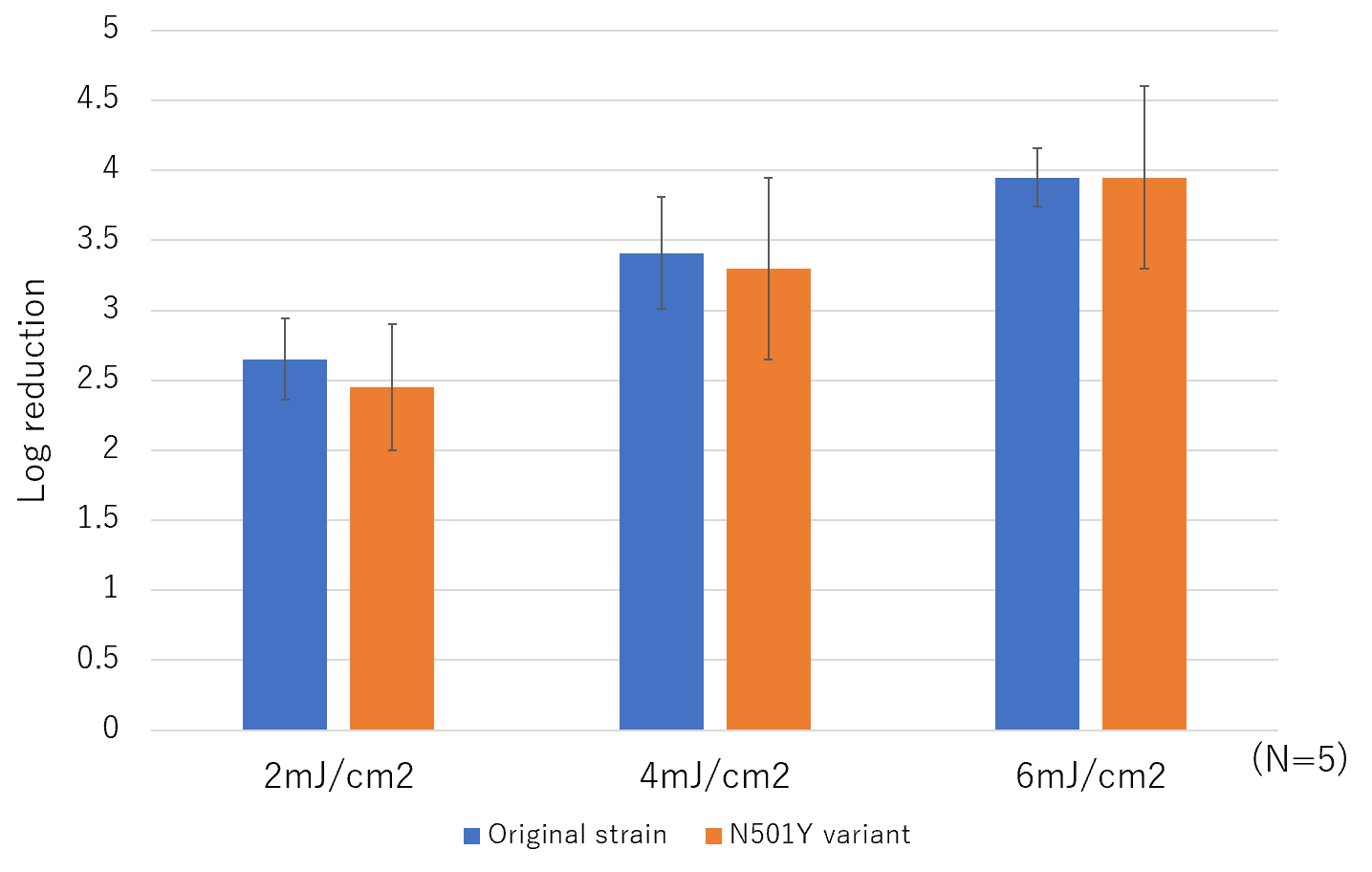
Each SARS-CoV-2 strain was irradiated with 222 nm UV-C at 2, 4, and 6 mJ/cm2 in a dry environment on plastic five times, and the inactivation effect was evaluated through comparison with control samples that were not irradiated with 222 nm UV-C. The results showed that the inactivation effect of 222 nm UV-C on the N501Y variant and the original strain was the same (no significant difference), as expected (Figure, Table).
Figure: The SARS-CoV-2 inactivation effects of 222 nm UV-C
Table: Data on SARS-CoV-2 inactivation by 222 nm UV-C
UV-C has been used for pathogen reduction for more than a century; it has been used in water treatment, HVAC applications, and to disinfect objects. Different microorganisms need to be exposed to different amounts of UV to be inactivated, but no microorganism is known to have acquired UV-C resistance. This research project demonstrated that the Care222 technology can be effective in inactivating SARS-CoV-2 variants.
(*1) All references to “disinfection” are referring generally to the reduction of pathogenic bioburden and are not intended to refer to any specific definition of the term as may be used for other purposes by the U.S. Food and Drug Administration or the U.S. Environmental Protection Agency.
(*2) Variant
In general, viruses with slightly different genome sequences appear through processes of copying and proliferation. These viruses with different genome sequences are called variants, and some variants will be more infectious or cause more severe symptoms due to the genome sequence changes.
(*3) Pyrimidine nucleotide frequency
The frequency of the pyrimidine nucleotides [TT (thymine-thymine), TC (thymine-cytosine), CT (cytosine-thymine), and CC (cytosine-cytosine)] in the genome sequence.
Reference materials
1)Kitagawa, H., Nomura, T., Nazmul, T., Omori, K., Shigemoto, N., Sakaguchi, T., & Ohge, H. (2020). Effectiveness of 222-nm ultraviolet light on disinfecting SARS-CoV-2 surface contamination. American Journal of Infection Control, 49. https://doi.org/10.1016/j.ajic.2020.08.022
2)Kitagawa, H., Nomura, T., Nazmul, T., Kawano, R., Omori, K., Shigemoto, N., Sakaguchi, T., & Ohge, H. (2021). Effect of intermittent irradiation and fluence-response of 222 nm ultraviolet light on SARS-CoV-2 contamination.Photodiagnosis and Photodynamic Therapy, 33. https://doi.org/10.1016/j.pdpdt.2021.102184
3)Collier, D. A., De Marco, A., Ferreira, I. A. T. M., Meng, B., Datir, R., Walls, A. C., Kemp S, S. A., Bassi, J., Pinto, D., Fregni, C. S., Bianchi, S., Tortorici, M. A., Bowen, J., Culap, K., Jaconi, S., Cameroni, E., Snell, G., Pizzuto, M. S., Pellanda, A. F., … Gupta, R. K. (2021). Sensitivity of SARS-CoV-2 B.1.1.7 to mRNA vaccine-elicited antibodies. Nature. https://doi.org/10.1038/s41586-021-03412-7
4)Blatchley, E., Brenner, D., Claus, H., Cowan, T., Linden, K., Liu, Y., Mao, T., Park, S. J., Piper, P., Simons, R., Sliney, D., (May, 12 2021) . Far UV-C Radiation: Current State-of Knowledge. The International Ultraviolet Association.https://iuva.org/resources/covid-19/Far%20UV-C%20Radiation-%20Current%20State-of%20Knowledge.pdf
5)Pendyala, B., Patras, A., Pokharel, B., & D’Souza, D. (September 2020). Genomic Modeling as an Approach to Identify Surrogates for Use in Experimental Validation of SARS-CoV-2 and HuNoV Inactivation by UV-C Treatment. Frontiers in Microbiology. https://doi.org/10.3389/fmicb.2020.572331
Ushio's Care222 filtered far UV-C disinfection technology
Ushio’s Care222 technology combines an excimer lamp with a peak wavelength of 222 nm with a special optical filter to block wavelengths above 230 nm. Irradiation with UV-C light with wavelengths above 230 nm can be harmful to skin and eyes if they are exposed for an extended period.
Hiroshima University Hospital (Minami Ward, Hiroshima City)
Hiroshima Prefectural Vocational School and the affiliated hospital, which became the predecessor organization of the current university, were founded in 1945. It then became a prefectural medical university and finally a national university in 1953. It is one of Japan's best medical institutions with advanced medical technology and has 47 healthcare departments, including medicine and dentistry. It contributes to the only child cancer hospital in the Chugoku and Shikoku regions and regional healthcare by coordinating with the authorities and other medical institutions, for example during disasters and the current COVID-19 pandemic.
https://www.hiroshima-u.ac.jp/en/hosp
___




