
LEDs & Light Sources
Philips Demonstrates World’s First Mains-Powered White-Light OLED Module
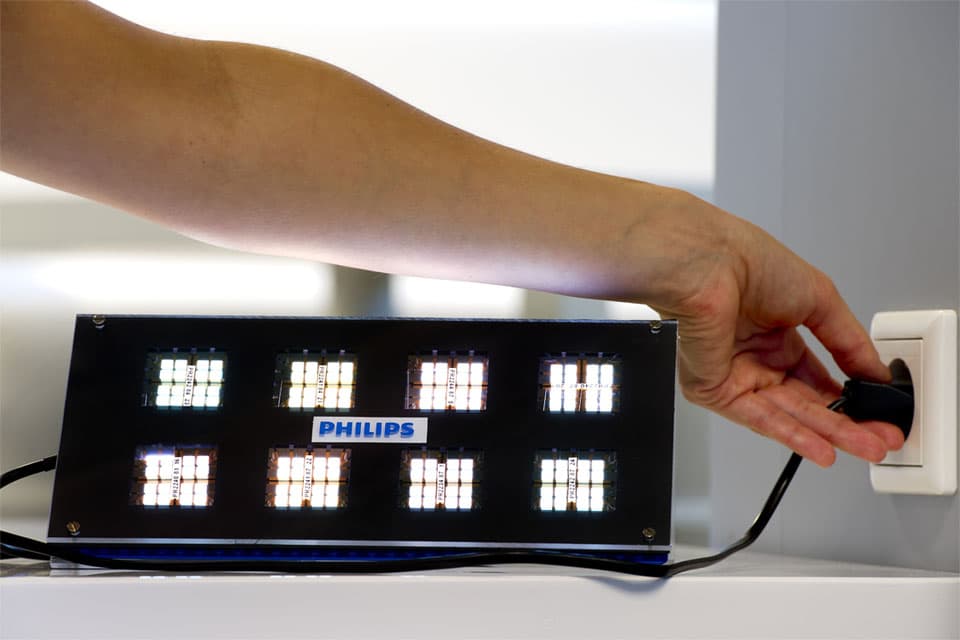
Scientists from Philips Research have developed the first-ever organic light emitting diode (OLED) module that can be powered directly from a mains electricity supply. The prototype opens the door to OLED systems that can be directly plugged into standard power outlets without the need for bulky…
OLEDs offer a completely new vision of lighting. Like LEDs, OLEDs are solid-state lighting devices that are extremely efficient light emitters – thus helping reduce the financial and environmental costs of lighting. Next to LEDs offering very high brightness in a compact shape, OLEDs emit light over an extended area. The illumination they produce is “calm”, glowing and diffuse, and non-glaring. The thin, flat nature of OLEDs makes it possible to create light sources of a wide variety of shapes and sizes.
Moreover, OLEDs are fully dimmable and can produce many different colors as well as whites, including the kind of white light people appreciate from traditional light sources. This makes them an extremely attractive option for general illumination.
However, until now, the physical characteristics of OLEDs have meant they have had to be powered from low-voltage direct current (DC) sources. In contrast, the AC-powered white-light module developed by Philips Research can be plugged directly into a mains wall socket.
“We have combined proprietary interconnect and packaging technology to create this demonstrator,” says Dr. Dirk Hente of Philips Research. “We’re already seeing AC-driven LEDs coming onto the market. Our prototype marks a breakthrough step towards a similar evolution in OLEDs.”
Eliminating the need for driver electronics could bring many advantages for luminaire manufacturers. Because it reduces the number of components in a finished system, it makes system integration and assembly simpler, improves end-product reliability and enables faster time-to-market. Moreover, it increases design freedom and expands the range of potential OLED applications.
Philips began researching OLEDs in 1991. Today, Philips Lighting is a leader in the industrialization and commercialization of OLED lighting technology, with its Lumiblade family of products (www.lumiblade.com). This latest breakthrough is an important step forward in supporting Lumiblade systems that will enhance people’s lives with light.
Philips Research has developed its AC-powered module in collaboration with Dipl.-Phys. Holger Spahr, Institut für Hochfrequenztechnik, TUBraunschweig, Germany as part of the TOPAS 2012 project. This project, funded by the German Federal Ministry of Education and Research (BMBF), brings together leading industrial and academic organizations to develop OLEDs for lighting systems of the future.




