
LEDs & Light Sources
Future Lighting Solutions launches Usable Light Tool
Often, when evaluating high-power LEDs, typical flux values, which are measured at a junction temperature of 25°C, are considered only. Such an analysis is incomplete and inaccurate for determining the expected level of light from the light source in a "real world" environment.
The purpose of this tool is to provide a true "real world" evaluation and comparison of high-power LEDs by taking into account the effects of 7 critical relationships (see diagram):
Working principals of the Usable Light Tool
While respecting the maximum Junction Temperature specified, the Usable Light Tool optimizes the Drive Current to maximize the light output of the selected LED. The models created for each LED are based on values obtained directly from the LED manufacturer's datasheets. The tool incorporates 3 major sources of data as well as a variety of secondary data points, which are explained below.
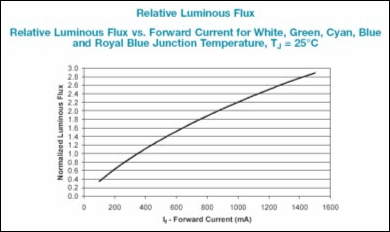
Data Source 1: As seen in the graph below the Light Output increases as the Drive Current does.
However, as the drive current increases, so does the power consumption, and the greater the power consumption, the more heat is generated.
Data Source 2: As seen in the graph below, as the Drive Current increases, the Forward Voltage increases.
Since power consumption is the product of current and voltage, the rise of Forward voltage also increases the power consumption, which generates additional heat.
Data Source 3: Finally, as seen in the graph below, the Light Output decreases as the Junction Temperature increases.
The Usable Light Tool also incorporates the following data points for running it's proprietary current optimizing algorithm:
- Ambient Temperature
- Heat Sink Thermal Resistance
- Power LED Junction to Case Thermal Resistance
- Effects of Junction Temperature on Forward Voltage
- Recommended Junction Temperature
- Number of LEDs
- Maximum allowable Drive Current
- Power LED Flux Bin
- Power LED Forward Voltage Bin
As was stated above, the Usable Light tool calculates the drive current that will maximize the usable flux that will not exceed the advised maximum junction temperature. However, the optimal current also maximizes the luminous efficacy for the calculated maximum usable flux. Therefore, the optimal current may not always be the maximum current.
See Future Lighting Solutions in our buyer's guide.




