
Automotive Lighting
FlatLight Micro-Optics Technology
Smaller, more efficient, better: The miniaturisation trend is also unstoppable in the automotive industry because it reduces installation space and weight and thus ultimately saves energy. "In addition, a car must have character and emotional appeal above all," says Dr. Frank Huber, who as HELLA…
Published by LED professional ·
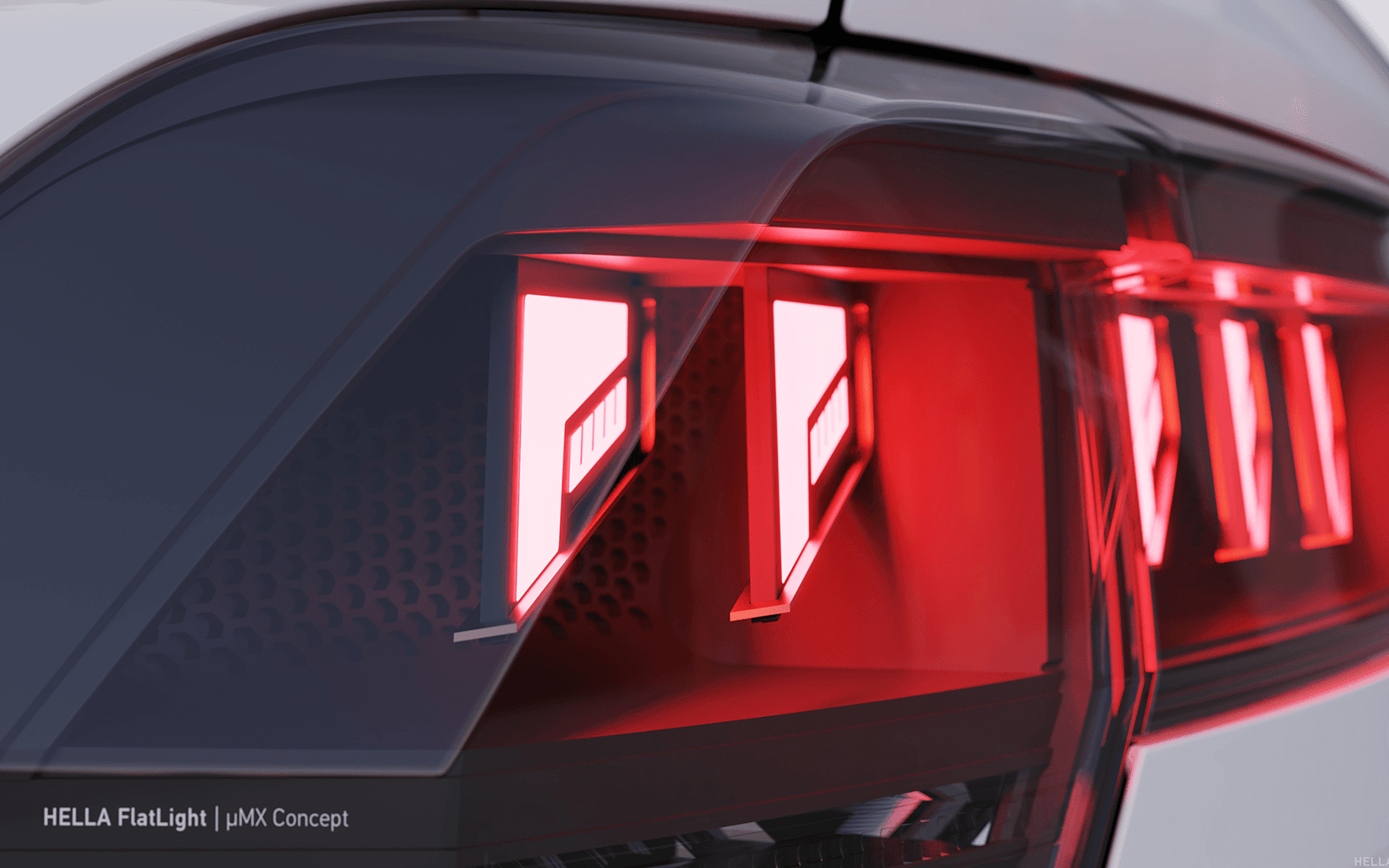
The HELLA FlatLight concept takes styling, function and performance to a new level. This is made possible by an innovative light guide concept which is based on micro-optics. These optical lenses are smaller than a grain of salt. The optics, which are only a few micrometers in size, allow the diffraction properties of light to be exploited. "This will fundamentally change light signatures as we have known them," says Dr. Huber.
Another major advantage of the new concept is that less energy is required compared to other technologies. Thus, only one watt is required to reproduce all tail light functionalities. Direction indicator, brake and tail light can be implemented in just one optical element. Until now, individual chambers were necessary for this. In addition, multi-colour combinations, such as those required for tail light/direction indicator or daytime running light/direction indicator, are also possible in just one element. In addition, the shape of the individual optical elements can be freely designed. Complex welcome and farewell scenarios can not only be designed via the HELLA software interface, but also implemented directly. In addition, fonts, logos and other graphics can be added.
The structure of the HELLA FlatLight, which is only a few millimetres thin, offers greater design freedom. The implementation with micro-optics (FlatLight µMX) is only one possibility to build the rear combination lamp. Depending on the customer's wishes and requirements, other technologies can also be used, such as nanoparticles. These enable, for example, three-dimensionally curved optical elements that can follow a vehicle contour even better and thus lead, among other things, to a reduction in installation space and weight savings.
HELLA has been successfully driving technical development in the rear combination lamp sector for decades. In 2001, the company integrated the first LED light guide rods into headlamps and rear combination lamps and has continued to develop the technology. HELLA is now setting a further milestone with the FlatLight approach. The company is currently intensely discussing this with customers and planning to bring the new technology to market within the next three years. The first variants of this lighting innovation have already been released for series production.




