Automotive Lighting
Intelligent light in the software-defined vehicle
In a blog post of 15 October 2026, Dr. Jörg Strauss, head of ams OSRAM’s LED, IRED and Laser business, frames automotive lighting as Digital Photonics: emitters, sensors and software working together in the software-defined vehicle. He covers EVIYOS microLED headlamps with 25,600 pixels, ALIYOS LED-on-foil, RGB-i interior LEDs and IR emitters for driver and occupant monitoring.
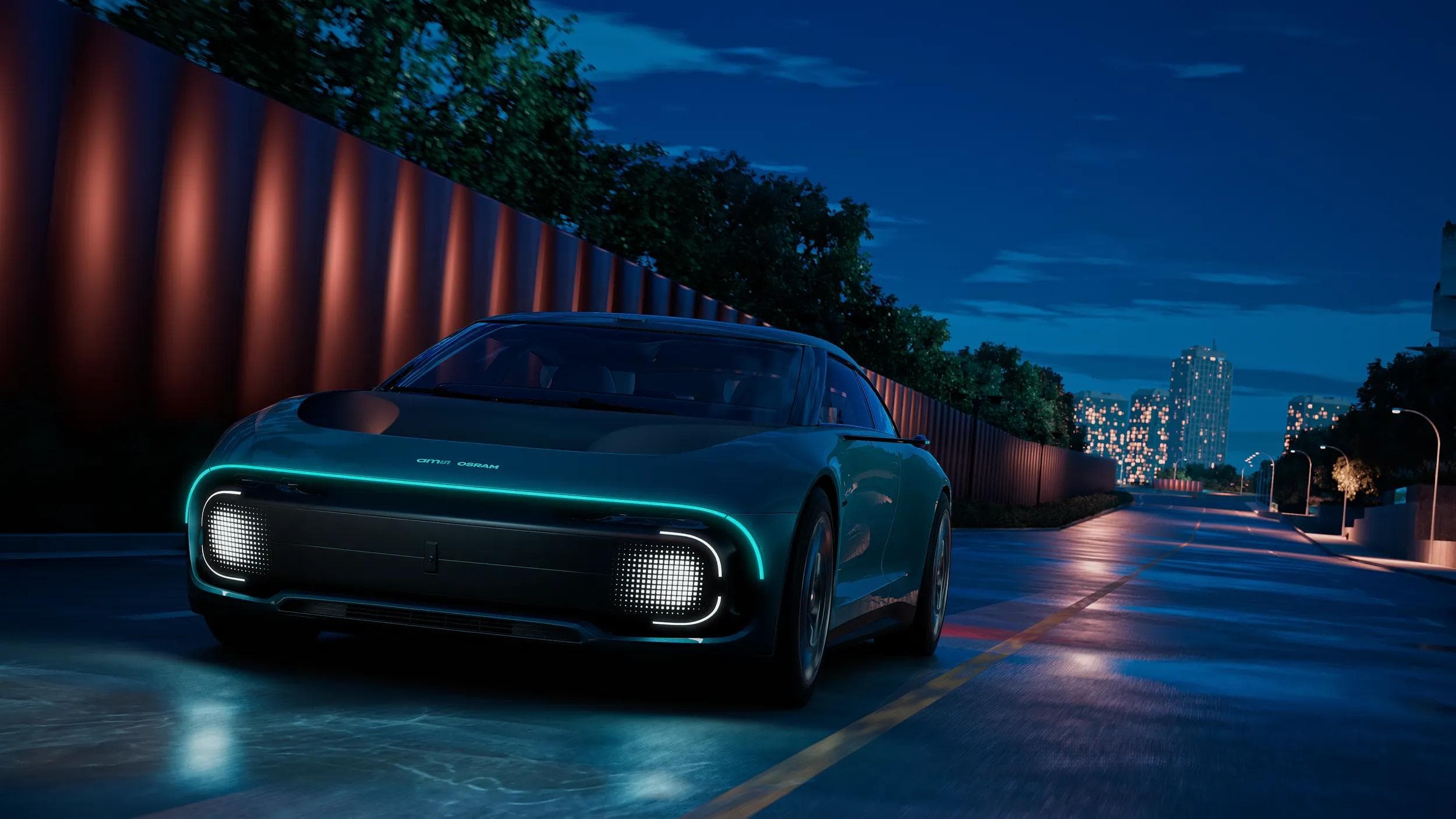
Automotive lighting has moved on from swapping bulbs for LEDs. In a recent post on the ams OSRAM innovation portal, Dr. Jörg Strauss, who has headed the company’s LED, IRED and Laser business since August 2026, argues that the real value of optical technology in cars now comes from systems that combine emitters, sensors, data processing and software. LED professional summarizes his argument below.
The post, published on 15 October 2026 under the title “Intelligent light transforms the driving experience”, ties ams OSRAM’s product roadmap to the software-defined vehicle (SDV) and to what the company calls Digital Photonics. It is a strategic piece rather than a product announcement, but it names the technologies the company is betting on, namely EVIYOS microLED, ALIYOS LED-on-foil, RGB-i interior LEDs and infrared emitters for cabin monitoring, and explains where each fits in the next generation of vehicle architectures.
For the SSL industry the post is worth reading for two reasons. First, it shows how a major LED maker now frames its automotive business: as a system supplier that anticipates use cases, rather than a component vendor meeting OEM specifications. Second, it spells out what the company considers its competitive foundation, from manufacturing capacity and supply chain to IP, including its patent exchange with Nichia. The original text is available on ams-osram.com; the structure of the post is kept in the sections that follow.
From LED retrofit to system change
The first wave of optical innovation in cars, roughly the first two decades of this century, was a substitution story. LEDs replaced incandescent lamps in headlamps and rear lamps, bringing longer life and lower power draw, which in turn improved convenience and fuel efficiency. Strauss is careful to call this an evolution, not a revolution: the component changed, but the job it did, illuminating the road and signaling, did not.
The current wave, he argues, is different in kind. The goal is no longer a brighter LED or one more optical sensor bolted onto an electronic control unit (ECU). Instead, emitters, sensors, processing and software are designed to work as one system, and that system changes how the vehicle relates to its driver and its surroundings. ams OSRAM’s innovation effort in this space is concentrated on safety-related functions: night vision, ADAS, and driver and occupant monitoring.
Strauss highlights three product families that embody this approach:
- Adaptive, microLED-based forward lighting
- LED-on-foil (ALIYOS) and self-calibrating RGB-i LEDs for exterior and interior applications
- Infrared emitters for driver and occupant monitoring systems
He also notes that these technologies can be tuned to the differing regulatory regimes in Europe, North America, China, Japan and Korea, a point of practical importance for any Tier 1 or OEM working across regions.
Intelligent light and the SDV
The opening for intelligent light systems is tied to a change in vehicle computing. The software-defined vehicle replaces hundreds of distributed ECUs with a powerful central compute platform. That platform can coordinate the sensors, network links, user interfaces and motion controllers behind ADAS and automated highway driving, and it can be updated over the air, so functions and safety features improve after the car has left the factory.
For a lighting supplier this matters because a pixel-level headlamp or a segment-addressable foil only becomes useful when something intelligent is controlling it. In the SDV, that control exists. ams OSRAM has responded by broadening its strategic scope from LEDs to what it calls Digital Photonics: the integration of optical sensing, light emission and digital control into one discipline.
Infrared in-cabin sensing: invisible IR light lets a camera monitor driver and occupants at night (Image: ams OSRAM)
The practical consequences range from headlamps that both illuminate the road and communicate with other road users to interior lighting that shifts color to set the mood in the cabin. Strauss adds that some of these use cases were not on the car makers’ own wish lists; they emerged from the supplier’s understanding of what the combination of light and intelligence makes possible.
Optical technology for safety and comfort
The clearest example in the post is EVIYOS, ams OSRAM’s microLED light source for headlamps. The device integrates 25,600 emitters together with the LED driver in a single chip-scale package, so every one of those points can be addressed as an individual pixel. The first application is adaptive driving beam (ADB): paired with object detection, the headlamp dims only the segments that would dazzle oncoming drivers or pedestrians, and keeps the rest of the road fully lit.
In an SDV the same pixel array can do more than avoid glare. Strauss gives two examples: projecting a beam exactly as wide as the car, so the driver can judge whether it fits through a narrow gap, and widening the beam toward one side during a lane change to signal the driver’s intention to surrounding traffic. His point is that these functions were not specified by customers; they came from the supplier anticipating a use case.
ALIYOS, the company’s LED-on-foil technology, takes a different route. The paper-thin module produces what the post calls light from nowhere: it can be embedded in exterior body panels or the dashboard, with individually controllable segments that display information, draw the driver’s attention or personalize the vehicle’s appearance. Light becomes an active interface between the car, its occupants and its environment.
For the cabin, RGB-i LEDs address a more mundane but costly engineering problem. Ambient lighting assemblies can contain hundreds of point sources, and keeping their color consistent is laborious. RGB-i emitters are self-calibrating, hundreds of them can hang off a single microcontroller, and they change color on demand, which opens the door to interiors whose accent lighting follows the music, the time of day or the mood of the occupants. Strauss positions both ALIYOS and RGB-i as a springboard for OEM design teams and for a new reading of brand identity.
Occupant monitoring scans the whole cabin, for example to adapt airbag deployment to where people are seated (Image: ams OSRAM)
The fourth strand is infrared. In driver monitoring systems (DMS) and occupant monitoring systems (OMS), IR emitters light the cabin invisibly so that an IR camera can see it. A DMS checks whether the driver is watching the road and detects impairment such as drowsiness, raising visual and acoustic alerts; it is also central to a safe handover between manual and automated driving. An OMS scans the whole cabin to locate occupants, information that can be used to adjust airbag deployment, for example for a rear-facing child seat on the front passenger seat. Here ams OSRAM’s role is as much advisory as it is supply: helping OEMs choose and deploy the right emitter.
The future for light intelligence
The post closes with what ams OSRAM considers the basis for delivering Digital Photonics into series production. Strauss lists five capabilities:
- Volume manufacturing across LEDs, microLEDs, VCSELs, lasers, on-wafer optical filters and advanced packaging
- Decades-long OEM relationships, which he sees as essential for fields such as ADAS where lighting and software must be co-developed early rather than handed over as a classical requirement specification
- A geographically diverse supply chain built to keep customers’ production running
- A secure IP position covering products, software and data models, reinforced by the patent exchange with Nichia, which also gives customers a second source
- Manufacturing and design quality that supports long-term reliability in the application
Behind these he places a cultural factor: a belief in continuous innovation as the company’s contribution to the automotive industry’s growth.
From an industry perspective, two of these points stand out. The emphasis on early co-development over specification-driven procurement signals a change in how lighting is engineered into the car, and one that favors suppliers with system know-how over pure component makers. And the explicit mention of the Nichia patent exchange as a market-confidence measure shows how much IP security now weighs in automotive sourcing decisions for microLED and related technologies.
About the author of the original post
Dr. Jörg Strauss, Head of LED, IRED and Laser business, ams OSRAM (Image: ams OSRAM)
Dr. Jörg Strauss is an Executive Manager at ams OSRAM with more than 20 years in lighting, sensing and photonics. He joined OSRAM in Regensburg in 2002 and moved from technology roles into senior leadership positions in Germany and the US. After leading the Visualization & Laser business, he joined the ams OSRAM Management Team in 2023 as Executive Vice President for Corporate Quality and R&D. Since August 2026 he has headed the LED, IRED and Laser business. He holds a PhD in Organic Chemistry from the University of Regensburg.
Source: Intelligent light transforms the driving experience, ams OSRAM Innovation, published 15 October 2026. This article is an editorial summary by LED professional.