
LEDs & Light Sources
Dynamically Programmable, Four-String HB LED Driver Maximizes System Flexibility
Maxim Integrated Products (NASDAQ: MXIM) introduces the MAX16826 programmable, four-string high-brightness (HB) LED driver for white, RGB, and RGB-plus-amber LED configurations. Designed to enable the transition to green lighting technology in automotive applications, this device maximizes system…
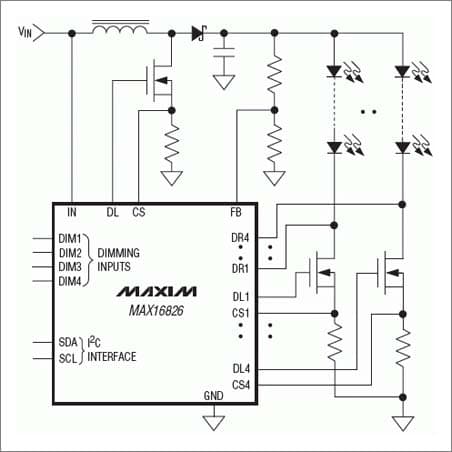
The MAX16826 integrates a switching regulator controller; a 4-channel, linear current-source driver; an ADC; and an I²C interface. The I²C interface allows dynamic programming of the output voltage to maximize power efficiency; it also allows manufacturers to program LED current for each string to accommodate LED binning variations, thereby reducing implementation cost.
Offering an unparalleled combination of configurability and performance, the MAX16826 is ideal for backlighting automotive infotainment displays, automotive display clusters, industrial and desktop monitors, and LCD TVs. It is also well suited for adaptive front lights and low-/high-beam assemblies, as well as other solid-state lighting (SSL) applications.
Automotive OEMs Are Transitioning to Green Lighting Technology:
With the traction of green initiatives among consumers, OEMs are shifting from CCFLs to HB LEDs for automotive backlighting applications. HB LEDs consume less power, and they do not contain hazardous materials such as the mercury in CCFLs. Moreover, consumers benefit from the enhanced color reproduction and longer lifespans of HB LEDs.
Yet, HB LEDs also pose unique challenges, particularly when used in the harsh operating environment of automotive applications.
Challenge #1: Improving the Price-to-Performance Ratio of HB LEDs:
First and foremost, designers must improve the price-to-performance ratio of HB LED solutions to make them cost competitive with CCFLs. Towards this end, there is significant demand for integrated devices that reduce the bill-of-materials and implementation costs. Automotive applications, in particular, require solutions that are highly flexible and scalable from low-end cars to luxury vehicles with development costs dispersed over many different platforms and car models.
It is difficult to meet the needs of multiple designs with the same HB LED driver circuit. Typically, designers must change components in their design in order to accommodate LED binning (i.e., brightness) variations, maximize efficiency, or reduce power dissipation for each project. This process is time consuming and costly.
Challenge #2: Integrating Fault Protection and Maximizing Conversion Efficiency:
The high-reliability standards of automotive applications typically require HB LED driver circuits with fault protection. If an LED fails, it can suddenly short or become an open circuit. In both cases, the HB LED driver circuit must be able to protect itself and the automotive electrical system, and, ideally, it should alert the electrical system of the fault condition.
Automotive LED applications also require advanced thermal-management capabilities. Excessive LED temperatures shorten their life and can cause them to fail. It is therefore important that the driver circuit includes a feature to limit the LED temperature if it exceeds a predetermined threshold.
Lastly, with all of the electronics in today's automotive environment, designers must maximize the efficiency of the HB LED driver circuit to minimize energy consumption from the battery.
Advanced Programming Capabilities Minimize Solution Cost and Improve Conversion Efficiency:
Specifically designed for automotive applications, the MAX16826 provides OEMs with a highly cost-efficient, scalable solution. The device's advanced programming features allow it to be used for multiple designs with minimal component changes. They also enable system manufacturers to accommodate LED binning variations, thereby reducing overall manufacturing cost.
The MAX16826 employs an innovative architecture that allows dynamic programming of the switching regulator's output voltage and the LED current amplitude in each channel. An internal ADC measures the drain voltage of each HB LED string. It then makes the measurements available to an external microcontroller through an I²C interface for output-voltage optimization and LED fault monitoring.
Dynamic programmability allows the same driver circuit to be used for multiple projects by simply adjusting the LED current or voltage through the I²C interface. This capability eliminates the need for component changes and greatly simplifies production. Moreover, output-voltage optimization maximizes conversion efficiency by reducing the voltage drop across the linear drivers. Consequently, it also reduces power dissipation and heat in the display.
Whereas existing designs employ integrated MOSFETs for LED current regulation, the MAX16826 drives external MOSFETs for both the switching converter and LED current regulators. This unique approach allows the device to drive more HB LEDs per string and more LED current across each string, thus enabling designers to utilize the MAX16826 for multiple projects. It also improves thermal management, because heat is dissipated by more components, and over a larger board area.
Integrated Fault Monitoring Reduces External Component Count:
The MAX16826 is able to detect and react to LED open- and short-circuit faults. Whenever a fault is detected, the IC triggers internal circuits, which immediately disable the faulty elements. This integrated fault monitoring protects the HB LED driver and the automotive electrical system from damage. In addition, the automotive electrical system can read the fault condition through the device's I²C interface, and react accordingly.
The MAX16826's advanced features enable designers to meet the high-reliability requirements of automotive applications, while minimizing external component count and, therefore, solution cost.
Additional HB LED Driver Benefits:
For enhanced flexibility, the switching regulator can be configured as a boost or SEPIC converter; the voltage across the driven LEDs can therefore be both higher and lower than the supplied input voltage. The MAX16826 also offers a programmable switching frequency (100kHz to 1MHz) to reduce electromagnetic interference (EMI) in noise-sensitive applications such as automotive displays. Additionally, each current sink features a direct-PWM input to enable independent LED-dimming control for each channel. Thus, designers can independently adjust the LED brightness for each color in RGB applications for optimum color control.
Additional features include cycle-by-cycle current limiting, output overvoltage protection, and overtemperature protection.
Designed for harsh operating environments, the MAX16826 is fully specified over the -40°C to +125°C automotive temperature range. The device can withstand load-dump transients up to 40V, and can operate under cold-crank conditions.
The MAX16826 is available in a thermally enhanced, 5mm x 5mm, 32-pin TQFN package. Prices start at $2.05 (1000-up, FOB USA). For more information please visit: www.maxim-ic.com/MAX16826-LED-Driver
Maxim Integrated Products is a publicly traded company that designs, manufactures, and sells over $2 billion of high-performance semiconductor products annually. It was founded over 25 years ago with the mission to deliver innovative analog and mixed-signal engineering solutions that add value to its customers' products. To date, Maxim has developed over 5800 products serving the industrial, communications, consumer, and computing markets. For more information, go to www.maxim-ic.com.




