McLED

LEDs & Light Sources

Back to Nature with Spectrum & Locus Adjustment (SLA)

SLA (Spectrum & Locus Adjustment) – The innovative Lightspot technology for precise definition of spectrum and color temperature.

Published by LED professional ·
Back to Nature with Spectrum & Locus Adjustment (SLA)

The light spectrum changes continuously from dawn to sunset. To ensure natural and healthy lighting with sun-like spectra, LEDs with different color temperatures are usually combined. However, if, for example, warm white light (2700 K) and cool white light (6500 K) is mixed, this does not result in a "true" neutral white with 4000 K.

The resulting mixed light merely suggests to our eyes that it lies between warm white and cold white - like how the human eye can be made to believe that a mixture of red and green light is yellow.

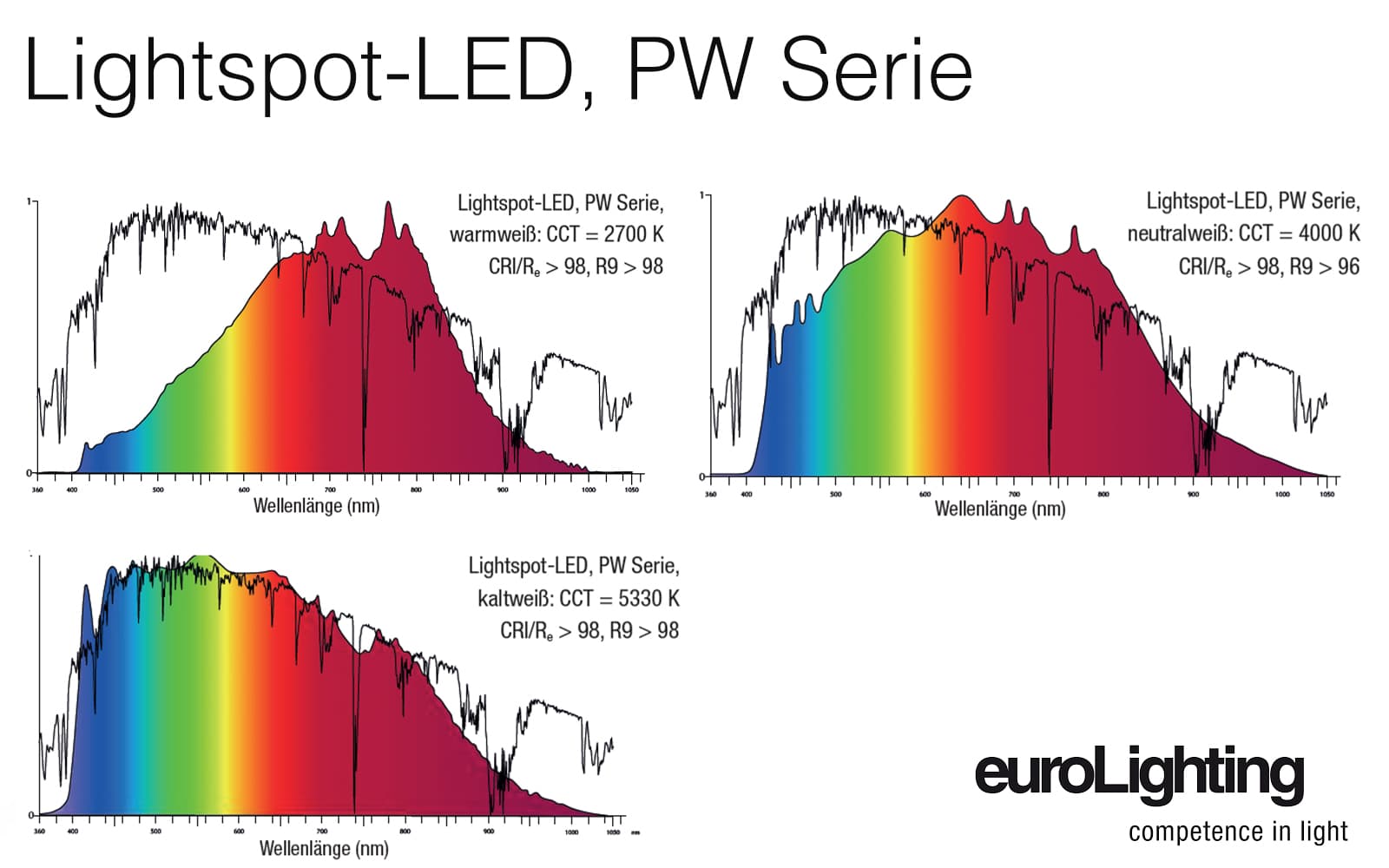
Lightspot's SLA technology makes it possible to produce any desired color temperature with a spectral distribution that lies on the blackbody curve. Or to put it another way: the correlated color temperature practically becomes a real one again: CCT = CT.

SLA technology is therefore perfectly suited to generating LED light with the optimum spectrum for any time of day. But it's not just the spectrum and color temperature that always match perfectly – all Lightspot LEDs that produce physiological light can offer optimum color rendering across the entire range of test colors from R 1 to R 15 (this corresponds to Re)!

The color rendering index for the SOL and PW series is CRI/Re> 98 for all available light colors.

The main difference between the SOL and PW series is the extended non-visual component in the near infrared (in PW). This makes the SOL ideal for all areas where, in addition to a broadband spectrum and outstanding color rendering is also increasingly about brightness and energy efficiency. The PW series is recommended the best physiological quality of light is required that can be achieved with LEDs today.

For more information contact euroLighting: www.eurolighting.de

Did you like this article?

Share this article

You could also like this

Digital Photonics

Polar Light and Foxconn explore MicroLEDs for data center links

Swedish MicroLED developer Polar Light Technologies has signed its first optical interconnect agreement – for links that carry data as light between chips and systems – with Foxconn Technology. Announced on November 12, 2026, the work focuses on 5 µm green MicroLEDs, the size Polar Light already makes on its pilot line, as light sources for AI data centers.

LEDs & Light Sources

ams OSRAM partners with Samsung Display, gains € 210 million investment

ams OSRAM and Samsung Display (SDC) will jointly develop next-generation ultra-small microLEDs for displays. SDC is also investing EUR 210 million in ams OSRAM for a stake of about 9.1%.

Smart Cities

Pulsiv opens early access to 80 W LED streetlight driver design

UK power electronics firm Pulsiv has opened an early access programme for an 80 W LED driver reference design for streetlights, announced on 24 November 2026. Built on its OSMIUM technology, the driver runs at 106–139 V so long-life dry polymer capacitors can replace failure-prone electrolytic ones, avoids the switch-on current surge that trips breakers, and targets 93 % efficiency at 230 VAC.

LEDs & Light Sources

Broadcom narrows the beam: RGB LED with 75° lens for signs

At electronica 2026 in Munich, Broadcom showed the LED professional team its ASCB-WTF0-0A30A: a tiny RGB LED (2.8 × 2.7 mm) whose built-in lens focuses red, green and blue light into a 75° cone instead of the usual 110–120°. More light reaches people standing in front of a sign – ideal for speed limit, highway message and taxi signs. Each color is driven separately.

Luminuscree ledEdison optoTE connectivityLTF TechnologyLoreos

The latest Press Releases

Explore All

Stay current with our monthly Update from the lighting industry

LEDprofessional Newsletter

You will receive a confirmation e-mail. Unsubscribe anytime.
