
Digital Photonics
6G LiFi Technology
Light-based technology, for making telecommunications more accessible in remote and rural areas, is to be developed in a collaboration between the University of Strathclyde and Friedrich-Alexander-Universität Erlangen-Nürnberg (FAU) in Germany.
Published by LED professional ·
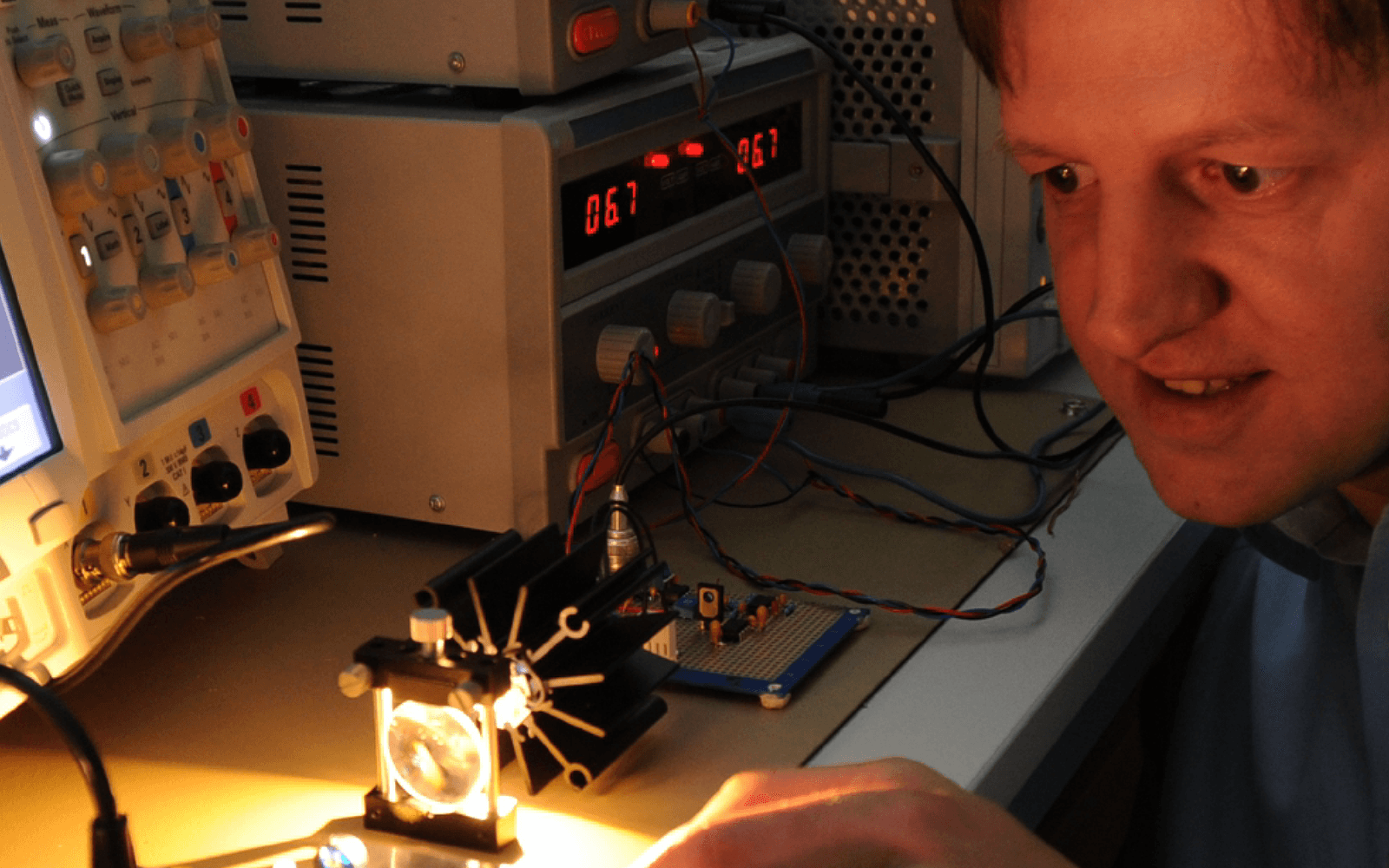
Professor Harald Haas, Director of Strathclyde’s LiFi Research and Development Centre, has received a Humboldt Research Award for his research achievements to date. This award enables him to collaborate on a topic of choice with Professor Robert Schober at FAU.
The collaboration will investigate the use of point-to-point free space optical (FSO) communications to provide an effective solution to the ‘digital divide’ through 6G communications.
The project will also explore THz (terahertz) communications, on frequencies between 300 GHz (gigahertz) and 10 THz, as well as optical wireless communications, between 10 THz and 1 PHz (petahertz).
In addition, the research will examine the use of reconfigurable intelligent surfaces (RIS) for all potential 6G frequency bands. RIS are electromagnetic devices with electronically controllable characteristics, which can manipulate the impact of an incoming signal.
Professor Haas is an Alexander von Humboldt Professor and a recognised pioneer in the field of LiFi, or light-based communications technology. In a 2015 TEDTalk, he publicly demonstrated for the first time new technology for receiving data with ordinary solar cells. His research offers a means of overcoming problems of access to technology, particularly in remote, rural or desert regions.
According to the International Telecommunication Union, 2.9 billion people – more than a third of the world’s population – have never used the internet.
Professor Haas said: “It is generally accepted that, to achieve step-change improvements in net-zero, data rates, latency, user experience and coverage, radically new solutions are required for 6G and overcoming the digital divide is particularly important post-COVID-19.
“People in data-deprived areas can really fall behind in the modern world and what is really transformational about this is the move away from radio spectrum to optical spectrum. We are aiming to use the optical communications spectrum in the infrared region to beam wireless data signals over hundreds of meters to tens of kilometres, using solar panels as both data receivers and energy harvesters. We have been running a trial in Orkney in which ordinary solar cells and laser transmitters have been used to quadruple the data rates of residents on Graemsay.
“Our goal is to have affordable free-space optical communications for 6G, in a framework which enables mesh and multihop networking to get around hills and obstacles. Our system is designed to be self-powered because we use solar panels simultaneously for power and data harvesting so that it could be installed anywhere, even on trees or any other mast where there is no access to the power grid. The operational carbon footprint of these communication systems is, therefore, zero.
“We are also aiming to redirect signals when something, an object or an individual, is in the way and blocking the signal. We will advancing optical RIS, which is something like a smart billboard or wallpaper that reflects and concentrates light towards a LiFi receiver.
"I have chosen to work with FAU because, like Strathclyde, it has a national and international reputation as a research-intensive and leading university. It is an absolute privilege to collaborate with Professor Schober, who is among the top researchers in wireless communications in the world," said Professor Haas
Humboldt research awards are presented by the Alexander von Humboldt Foundation to senior researchers who have predominantly lived and worked outside Germany for at least five years; are recognised internationally as outstanding researchers in their field; have had a significant impact on their own discipline and beyond, and are expected to continue producing cutting-edge research.




